Most authorization POCs fail quietly. Not because the technology didn't work, but because the POC was scoped wrong, measured the wrong things, or never had clear criteria for what "success" meant. The team runs a demo, builds a few test policies, nods along in a review meeting, and then the project stalls because nobody can confidently say whether it passed.
According to Sapphire Ventures' survey of Global 2,000 IT executives, 78% said that fewer than half of their POCs result in production deployments. The ones that do make it share a pattern. They're short, tightly scoped, measured against criteria defined before the POC started, and they involve the right people beyond just the engineering team.
This is a practical guide to running an authorization POC that gives you a real answer, not a demo you forget about.
Why authorization POCs are different
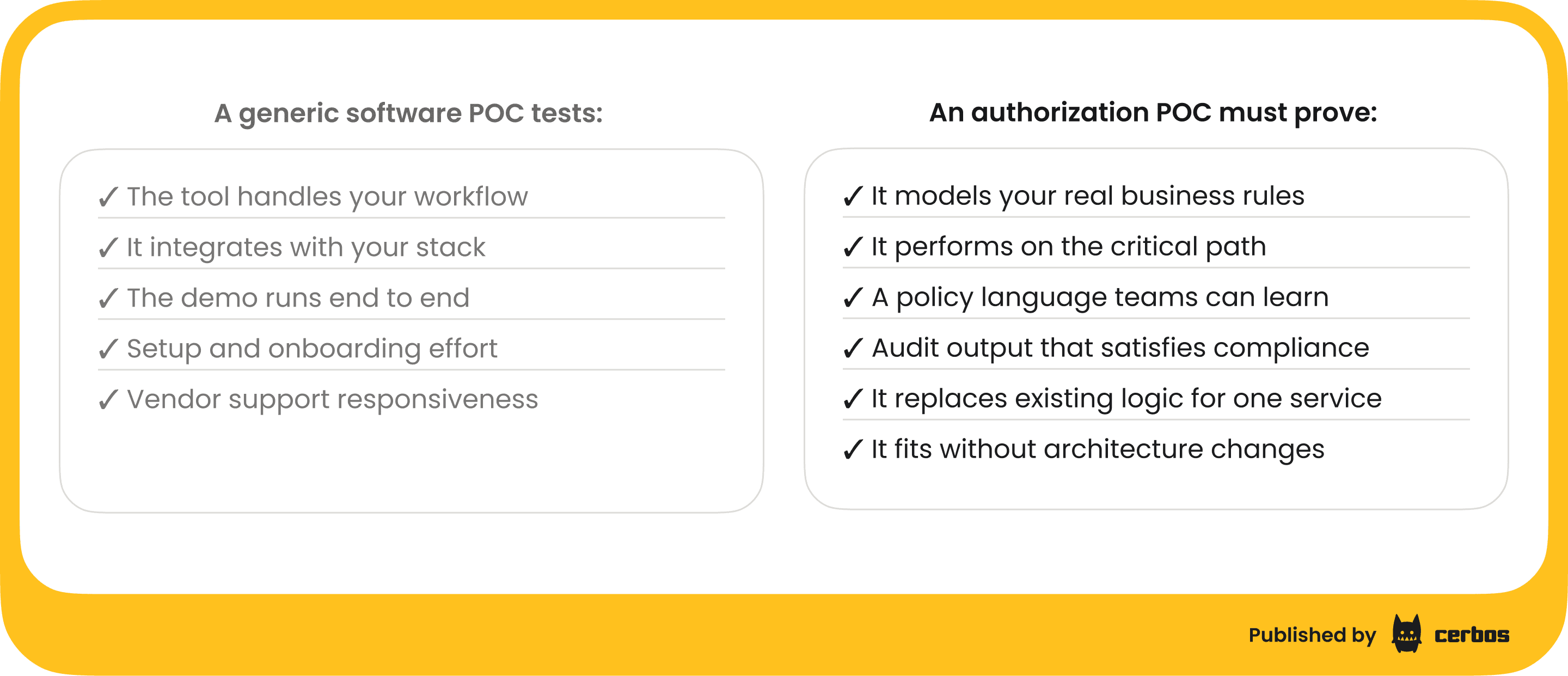
A generic software POC might test whether a tool can handle a workflow or integrate with your stack. An authorization POC has to answer a harder set of questions, because authorization touches every service, every request, and every user in your system.
You're not just testing whether the tool works. You're testing whether it can model your actual business rules, whether it performs under real load on the critical path of every request, whether your team can learn the policy language fast enough to maintain it, and whether the audit output satisfies your compliance requirements. These are different dimensions, and a POC that only covers one or two will leave you making a decision with incomplete information.
The other difference is that authorization is rarely greenfield. Most teams already have authorization logic scattered across their codebase. The POC needs to prove not just that the new system works in isolation, but that it can replace what you currently have for at least one real service without breaking things.
Scope it to one real service
The single most important decision in an authorization POC is scope. Too broad and the POC drags on for months, losing momentum and executive attention. Sapphire Ventures found that POCs lasting under three months are 3x more likely to result in successful production deployment. Too narrow and you test a toy scenario that doesn't prove anything about real-world fit.
The right scope is one real service with real users and real authorization requirements. Not a demo app. Not a sandbox with synthetic data. Pick a service that has enough complexity to be representative but isn't so critical that a failed POC creates organizational risk.
Good candidates for your POC service tend to share a few characteristics. The service has at least three or four distinct roles with different permission levels. It has some conditional access logic beyond simple role checks, things like "managers can approve expenses only in their own department" or "editors can publish documents only below a certain classification." It connects to your existing identity provider. And ideally, the current authorization implementation is causing some visible pain, whether that's slow permission changes, inconsistent behavior, or compliance gaps.
For more details, explore this framework for evaluating authorization providers.
At Complex, a single staff engineer implemented Cerbos across their entire authorization layer. The timeline was a few months from nothing to production, but a significant portion of that was cleaning up existing technical debt, not learning or configuring the new system. Without the debt cleanup, the implementation would have been much faster because the integration itself was straightforward. That's the kind of signal a well-scoped POC should surface: how much of the work is the new tool versus how much is untangling what you already have.
Define success criteria before you start
This is where most POCs go wrong. The team starts building before agreeing on what success looks like, and by the end, different stakeholders have different opinions about whether it worked.
Write down your success criteria before the POC begins. Make them specific and measurable. Here are the six questions your authorization POC should answer, drawn from our build-vs-buy evaluation framework.
1. Can it model your actual business rules?
Not a simplified version. Your real policies, including the edge cases your team currently handles with if-statements and hardcoded exceptions. If the policy language can't express your rules clearly, that's a hard stop. Look for whether policies are readable by people outside the engineering team. At Human Managed, the ability to express authorization rules in YAML meant that non-developers could review and validate policies directly, which removed a bottleneck that had previously required code changes and full redeployments for every permission update.
2. Does it handle the authorization patterns you need?
Basic RBAC is table stakes. Test whether the solution supports attribute-based conditions, relationship-aware rules, and tenant-scoped policies if you're building SaaS. The gap between "supports RBAC" and "supports the access model your application actually needs" is where many evaluations surface deal-breakers.
3. What's the latency under realistic load?
Authorization is on the critical path of every request. Run load tests that simulate your actual traffic patterns, not just peak throughput benchmarks. Measure p50, p95, and p99 latency. For most applications, you're looking for sub-millisecond decision times. Cerbos customers report 100,000+ checks per second in production with sub-millisecond latency, but what matters is your specific deployment topology and policy complexity.
4. Can a developer write a policy without extensive ramp-up?
Time a new team member from zero to writing a correct policy. If it takes weeks of training before someone can contribute, adoption will be slow and fragile. At Utility Warehouse, a FTSE 250 company running 4,500 services, the engineering team described Cerbos as taking a few days to understand and a couple of weeks to have up and running. That's the kind of learning curve that scales across a team. That's the kind of learning curve that scales across a team.
5. Does the audit output meet your compliance needs?
Have your security lead review the decision logs during the POC, not after. Check whether every authorization decision is logged with the requesting principal, the action, the resource, the policy version evaluated, and the outcome. If you need to reconstruct why a specific user had access to a specific resource on a specific date, the audit trail should answer that question without ambiguity. Cerbos Hub provides structured audit logs that meet SOC 2, ISO 27001, HIPAA, PCI DSS, and GDPR requirements, including a correlation ID that links authorization decisions back to application events.
6. Does it fit your architecture without forcing changes?
The authorization layer should consume identity context from your existing IdP without replacing it. It should deploy in a way that makes sense for your infrastructure, whether that's a sidecar in Kubernetes, a service in your cluster, or a hybrid approach. If the solution requires you to change how you handle identity or restructure your deployment model, that's a significant hidden cost. Sidecar deployments are typically the fastest path to production because they keep authorization calls local, avoiding complex networking and load balancer configuration.
Involve the right people
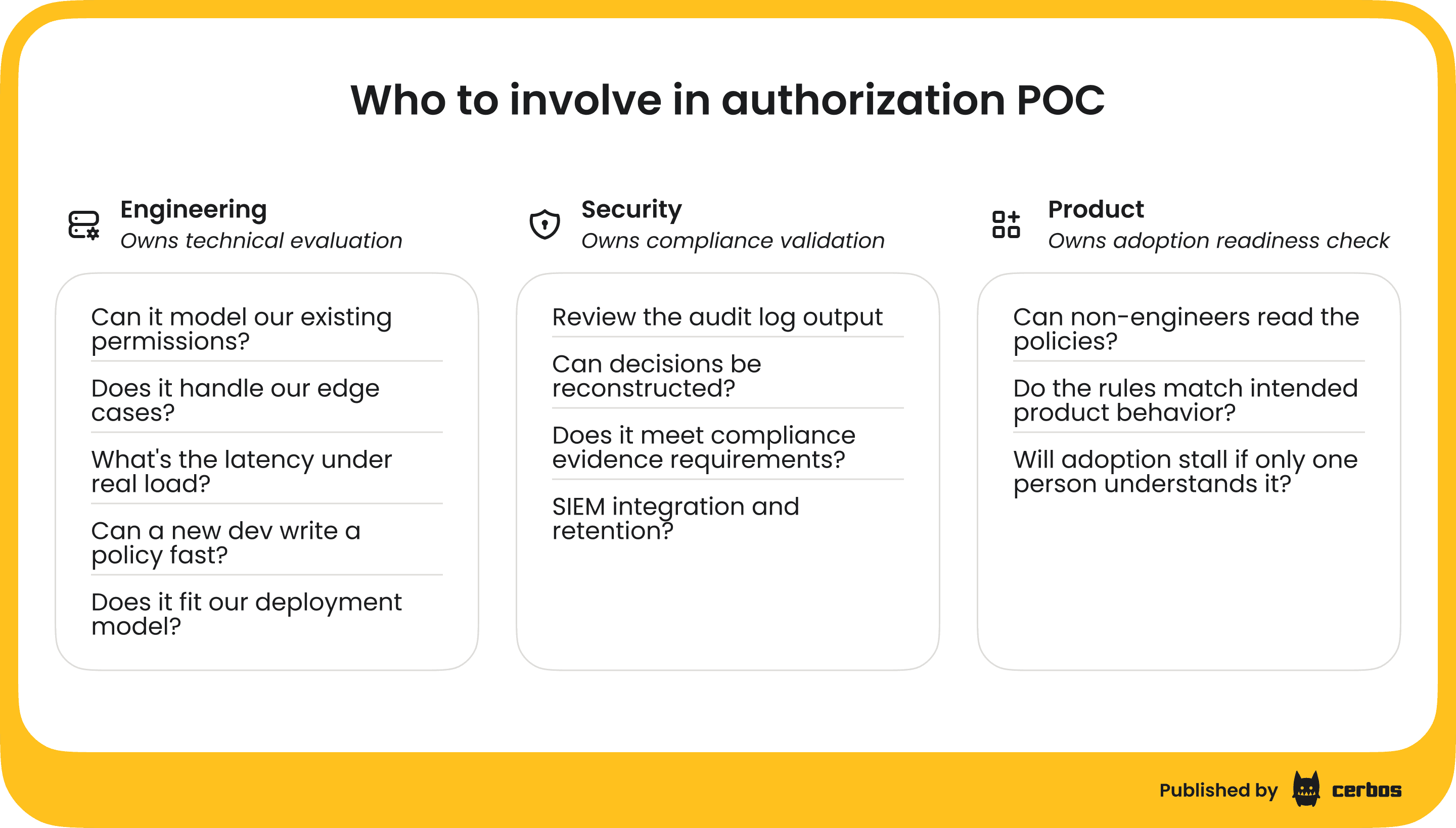
An authorization POC that only involves the engineering team will produce a technically valid evaluation that doesn't address half the questions stakeholders will ask when it's time to approve a production rollout.
Bring in your security lead to review the audit output and assess compliance readiness. Bring in a product manager to read the policies and confirm that the rules match the intended product behavior. If you're in a regulated industry, have someone from compliance review the decision log format and retention capabilities.
The goal is to surface concerns during the POC, not after. If the solution only makes sense to the engineer who configured it, adoption will stall the moment that person is unavailable.
Set a time limit
Authorization POCs should not run indefinitely. Two to four weeks is enough to answer the six questions above for a single service. If you're finding that you need more time, that's usually a signal that the scope is too broad or the success criteria weren't specific enough.
Set a hard deadline at the start. Schedule the review meeting before the POC begins. This creates natural urgency and prevents the evaluation from drifting into background work that never reaches a decision. POCs that stay under three months are 3x more likely to reach production than those that stretch longer.
Measure the baseline first
You can't evaluate "better" without measuring "current." Before the POC starts, document your baseline across the dimensions you care about.
How long does a permission change take today? At many organizations, updating who can do what means editing application code, running through a review cycle, testing, and deploying. At Human Managed, this process previously required source code changes and full redeployment. After externalizing authorization, the same changes took five minutes. That kind of before-and-after comparison is only possible if you captured the baseline.
How long does it take to onboard a new developer to your current authorization logic? How much engineering time per sprint goes to permission-related work? What does your current audit trail look like for authorization decisions, and how long does it take to prepare that evidence for an audit?
These baselines turn the POC review from a subjective discussion into a data-driven decision.
What a good POC outcome looks like
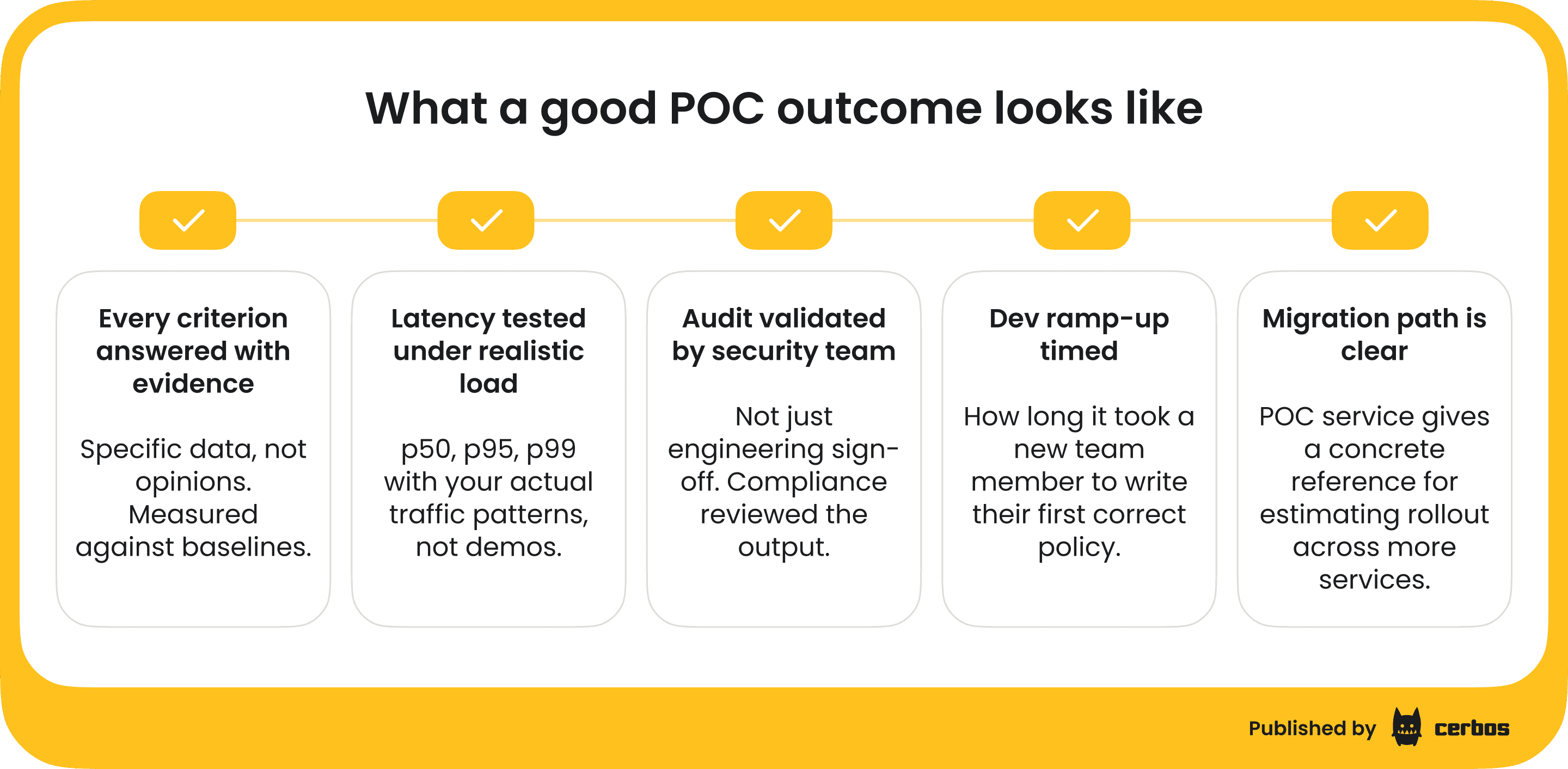
At the end of a well-run authorization POC, you should be able to answer every one of the six criteria with specific evidence, not opinions. You should have measured latency under realistic load, confirmed that your business rules can be modeled in policy, validated the audit output with your security team, and timed how long it took a new developer to write their first policy.
You should also have a clear picture of the migration path. The POC service gives you a concrete reference point for estimating the effort to roll out across additional services. If Loop saved three to six months of development time by choosing an external solution over building in-house, your POC should give you enough data to make a similar estimate for your own environment.
The teams that get authorization right tend to be the ones that treated the POC as a real engineering exercise, not a checkbox. Scope it tight, define success upfront, measure the baseline, involve more than just engineers, and set a deadline. The POC should give you confidence to commit, or confidence to walk away. Either is a good outcome.
Go deeper:
- Try Cerbos: authorization management platform for enterprise software and AI
- How to adopt externalized authorization (eBook) for a step-by-step playbook on decoupling authorization from application code
FAQ
Tagged in