If you are looking for a Permit.io alternative, it is usually because authorization has grown past where it started. A permissions service that worked for one product now has to cover dozens of applications, the gateways in front of them and the AI agents acting for your users. Or your security team has asked where the control plane runs, how long decision logs are kept and what it will cost at ten million users. The right replacement depends on which of those pressures you are under, and on which tools actually make the decision Permit.io makes.
What Permit.io does and who uses it
Permit.io sells fine-grained authorization as a service. Founded in Tel Aviv in 2020, it is built on open source projects. OPA, an open source policy engine, evaluates the policy, and OPAL, a sync layer Permit maintains, pushes policy and data to the decision points. Teams define resources, roles and relationships in a policy editor, the API or Terraform, and Permit generates the policy code from that model. Decisions run either in Permit's cloud on a managed decision point or in your own network on a container you run. Permit supports role-based, attribute-based and relationship-based access control (RBAC, ABAC and ReBAC), and it ships Elements, prebuilt screens your customers can use to manage users and request access inside your product. In 2026 it added an MCP gateway for AI agent tool calls.
Its published customer stories are mostly software companies that wanted permissions working quickly without building them, and the editor lets product and support staff change roles without a release. That is the baseline any alternative has to meet.
What Permit.io costs and how it is priced
Permit.io's pricing page (October 2026) lists a free Community tier with 1,000 monthly active users, 20 tenants, 25 roles, 50 resource types, 2,000 role assignments, 2,000 relationship tuples and 14 days of log retention. Paid tiers are priced on monthly active users and tenants, and the Pro tier showed no list price on the page when we read it. Enterprise is by quote and removes the user and tenant limits. Permit also added quotas on resources and rules to its paid tiers in a 2024 pricing change.
For comparison, the Cerbos authorization management platform publishes its pricing by monthly active principals, the people and services that get a decision in a month. Proof of concept is $0, Development starts at $25 a month, Production at $933 a month with a year of audit logs, and Enterprise is custom.
Why teams look for a Permit.io alternative
A second copy of your data to keep in sync. Permit's decision points answer from a local copy of your users, roles, tenants and relationships, synced from its control plane. That copy has to stay in step with your own databases, and at scale it gets large. Permit's own documentation, read in October 2026, says the Edge PDP, the decision point you run in your own network, holds data "in OPA's in-memory JSON document, so a large environment needs a large PDP". One Hacker News commenter put the general worry plainly, ending up with "a permissions database which is in a divergent state from your real application".
Capabilities that depend on where the decision runs. According to Permit's documentation (October 2026), ABAC runs only on the Edge PDP. The managed Cloud PDP does not evaluate ABAC or custom policy and allows 1,000 single checks a minute per client IP address. Teams that need attribute conditions in production end up running and sizing Edge PDPs themselves.
A control plane in someone else's cloud. Permit's default is a hybrid model with the control plane in Permit's cloud. Banks, carriers and payment companies we talk to often need the control plane inside their own infrastructure, and in Permit that is the Enterprise full on-premise deployment.
Authorization that stops at the application. Permit covers applications and APIs, and now MCP tool calls. Teams that want the same rules at the API gateway, the service mesh, the data platform and the Kafka topic need more than an application service.
Price as users and identities grow. Pricing by monthly active users and tenants, with quotas on roles and rules, is predictable for one product and harder to model across a whole enterprise.
An independent review reaches a similar view. It says "the abstraction is a dependency" and that "enterprise governance and scale features are still maturing relative to incumbents" (Start with Identity, June 2026).
Who needs a Permit.io alternative, and how urgently
Not everyone needs to move now. A single SaaS product with a handful of roles, running happily on the managed decision point, can wait until a renewal or a new requirement forces the question.
It is more urgent if any of these is true.
- You need attribute conditions at production volume and are already running and sizing Edge PDPs to hold your data.
- Your security or compliance team requires the control plane inside your own infrastructure.
- Authorization has to cover gateways, data platforms or AI agents as well as applications.
- You are rolling out AI agents and need every tool call checked and logged with the user behind it.
- Your user base, tenant count or non-human identities are about to grow by an order of magnitude.
- A renewal is coming, and you want a second option running against your own traffic first.
What to look for in a Permit.io alternative
Ask any replacement these questions.
- What is the source of truth for policy? A model in a vendor's console with code generated from it, or a policy file your reviewers read and approve?
- What does the decision point have to hold? A synced copy of your users and relationships, or only policy, with data read from the systems that own it?
- Are capabilities the same wherever the decision runs? Can every decision point evaluate roles, attributes and relationships, or does each deployment type support a different subset?
- How far does one set of policies reach? Applications only, or also API gateways, service meshes, data platforms, Kafka, Kubernetes and AI agents?
- What evidence does each decision leave, and for how long? Can you show the policy that was in effect at the time of any decision, months later?
- Where can the control plane run? Hosted only, or also in your own infrastructure, including air-gapped?
- Can your customers manage their own roles? Through an API your product can build on, with every change versioned and tested?
- Does it follow open standards? Does the decision API follow AuthZEN, so your enforcement points do not change if the decision service does?
- What does it cost at your real scale? Counting human users, tenants and non-human identities, plus the infrastructure you run alongside it.
For a full breakdown of what to look for when selecting an authorization solution - refer to our detailed framework.
The main types of Permit.io alternative
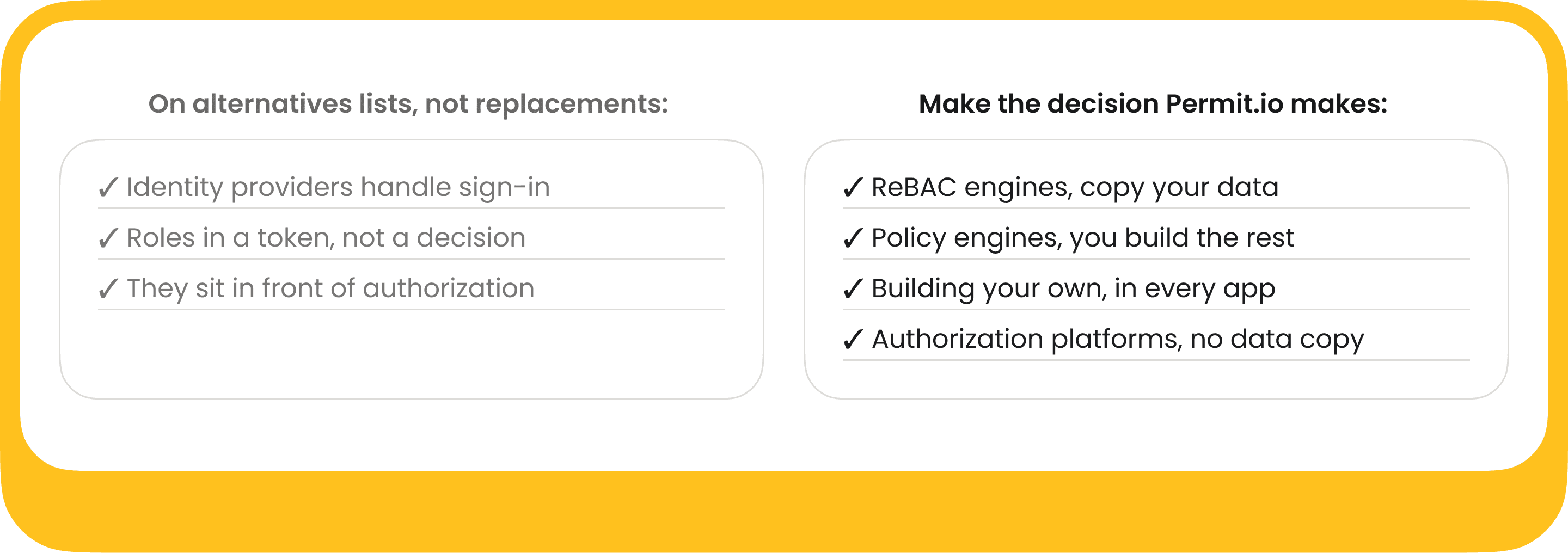
Lists of Permit.io alternatives mix tools that do very different jobs, and only some of them make the decision Permit.io makes.
Identity providers. Tools like Auth0, Keycloak and Ory show up on most alternatives lists. They handle sign-in, single sign-on and user directories, and they can put roles in a token. They do not make the fine-grained decision about whether this user may approve this invoice in this tenant at this amount, so they sit in front of an authorization layer rather than replacing one. Keep your identity provider and pick the authorization layer separately.
Relationship databases. Services modeled on Google's Zanzibar paper store relationships, such as who owns which folder and which group contains which user, and answer by walking that graph. They suit products built on deep sharing graphs. They also need every relationship written into them, and some add consistency tokens so a check does not run against a change that has not arrived yet. That is a second copy of relationship data to keep in sync, the same concern teams have with Permit.
General policy engines and languages. Open source engines that evaluate policy written in their own language. Permit itself generates Rega for one of them, OPA. They make fine-grained decisions, but on their own they leave policy distribution, testing, audit collection and data loading to your team.
Building your own. Authorization written into each application. It works until the number of services, tenants and auditors grows, and every change becomes a release. Our post on build vs buy covers where that line falls.
Authorization management platforms. A decision engine plus the management around it, policy authoring and testing, distribution to every decision point, audit collection, and context from your other systems. This is the type that covers both the decision Permit.io makes and the management Permit.io runs around it, and it is where Cerbos sits.
Open source alternatives. Several of the types above have open source options, including Permit's own decision point. The question to ask is less whether the engine is open and more who runs the rest, the policy lifecycle, distribution, audit and data around it. In Cerbos the decision engine at the core, Cerbos PDP, is open source under Apache 2.0, and the platform around it manages the rest.
Cerbos as a Permit.io alternative
Cerbos is an authorization management platform. Decision points run next to every workload, Cerbos Hub manages policy and audit, hosted or on-premise, and Cerbos Synapse brings in context and connects gateways, data platforms and AI agents.
Policy your reviewers read and approve, instead of a generated model
Where Permit generates policy code from a model in its console, a Cerbos policy is a short YAML file with conditions in CEL, reviewed in pull requests and tested before it ships. Allow and deny rules sit in the same file, and Cerbos Hub only builds a deployment when its tests pass. People who do not write YAML use the Hub playground and its RBAC policy generator, and a permissions matrix shows who can do what before a change is proposed.
Decision points that hold no copy of your data
Cerbos decision points are stateless. They hold policy only. The application sends the attributes it has, and Cerbos Synapse fetches the rest at decision time from the identity provider, database or API that owns it. There is nothing to sync, so nothing drifts, and decision points do not grow with your user base.
The same capabilities in every Cerbos deployment
Cerbos PDP evaluates roles, attribute conditions and derived roles in every deployment, whether it runs as a service, a sidecar, a DaemonSet or a serverless function. Relationship checks such as "manages this account" or "member of this team" become derived roles at decision time, with the relationship read from where it already lives. Nested structures such as regions, departments and folder paths are checked with hierarchy functions in the policy conditions.
Customer-managed roles through an API
Where Permit ships Elements, Cerbos gives your product the part underneath. Per-tenant policies live in their own Cerbos Hub policy stores, and your admin portal updates a tenant's roles through the Cerbos Hub API and SDKs, with every change versioned, tested and traceable to the decisions it affects. The screens are yours, in your product's design.
One policy set for applications, gateways, data and agents
The same Cerbos policies cover applications through SDKs, Envoy and Istio through Cerbos Synapse, Trino row filters and column masks, Kafka topics and Kubernetes admission control. For AI agents, every tool call through an MCP server is checked down to its arguments, and Claude Code tool calls are checked through its hooks. A role change applies on the next request everywhere, and every decision lands in one audit trail.
Evidence for every decision, kept as long as you need
Cerbos logs every decision with its inputs and outcome, linked to the policy version that made it, and Cerbos Hub collects the logs from every decision point into one searchable, exportable trail. Retention is three months on Development, a year on Production and custom on Enterprise.
A control plane you can host yourself
Decisions always run in your infrastructure, and keep running on the last policy they received if Cerbos Hub is unreachable. For enterprise customers, Cerbos Hub runs on-premise, including air-gapped.
Open standards and public pricing
Cerbos PDP implements the AuthZEN Authorization API. Alex Olivier, Cerbos cofounder and CPO, co-chairs the OpenID AuthZEN Working Group, so weigh our view on it with that in mind. Pricing is published, by monthly active principals, so you can model the cost before talking to anyone.
Proven at enterprise scale
The Cerbos platform runs more than 2 billion authorization checks a month, and Utility Warehouse uses it to govern access across more than 4,500 services and thousands of non-human identities, with millions of access decisions a day. Analysts cover it in our posts on Gartner's AuthZEN research and KuppingerCole's policy-based access management report.
When Cerbos is not the right Permit.io alternative
If your product depends on prebuilt user management and access request screens and you have no plan to build your own, or your core feature is a sharing graph many levels deep that you want the authorization service to store and walk, Permit.io or a ReBAC engine covers that case directly. For everything else, the switch can happen one service at a time.
Moving off Permit.io without a big bang cutover
You do not have to move everything at once, and your enforcement points can stay where they are.
- Inventory what Permit holds. Export your resources, roles, relationships and condition sets through Permit's API or Terraform, and note which decisions run on which type of decision point.
- Write the rules as Cerbos policies, with tests. Re-express the rules from the model, not from the generated code, and port the decisions you know must hold as tests.
- Decide where each piece of data comes from. Most attributes the application already has. The rest Cerbos Synapse fetches from the system that owns it, so you stop syncing users and relationships into a separate service.
- Run Cerbos in shadow mode. Send each check to both, keep enforcing Permit's answer, and log both until they match.
- Cut over one service at a time, then turn off its Permit decision points.
The migration guide walks through each step with a worked policy and tests, and Cerbos vs Permit.io compares the two section by section.
Book a call to map your Permit.io setup to Cerbos with our team and leave with a migration plan your security and audit teams can review, or try Cerbos to see your own policies tested, versioned and distributed.
Go deeper:
- How Cerbos works
- A guide to multitenant authorization (eBook), for per-tenant roles and isolation at scale
- How to adopt externalized authorization (eBook)
FAQ
Tagged in