If you are looking for a Cedar alternative, you probably have no quarrel with the language. What you are looking past is everything the language does not come with. Running the Cedar library in production means building the server around it, gathering every entity a request needs, working out how to list what a person can see, keeping a record of each decision, and getting a policy change safely to every service that embeds it. That work falls on the engineers, and the gaps show up for the identity team that owns the directory data and for the security team asked to show who could access what.
This guide covers Cedar the open source language and engine. If you run Cedar through Amazon Verified Permissions, AWS's managed service, our Amazon Verified Permissions alternatives guide covers that case.
Why teams look for a Cedar alternative
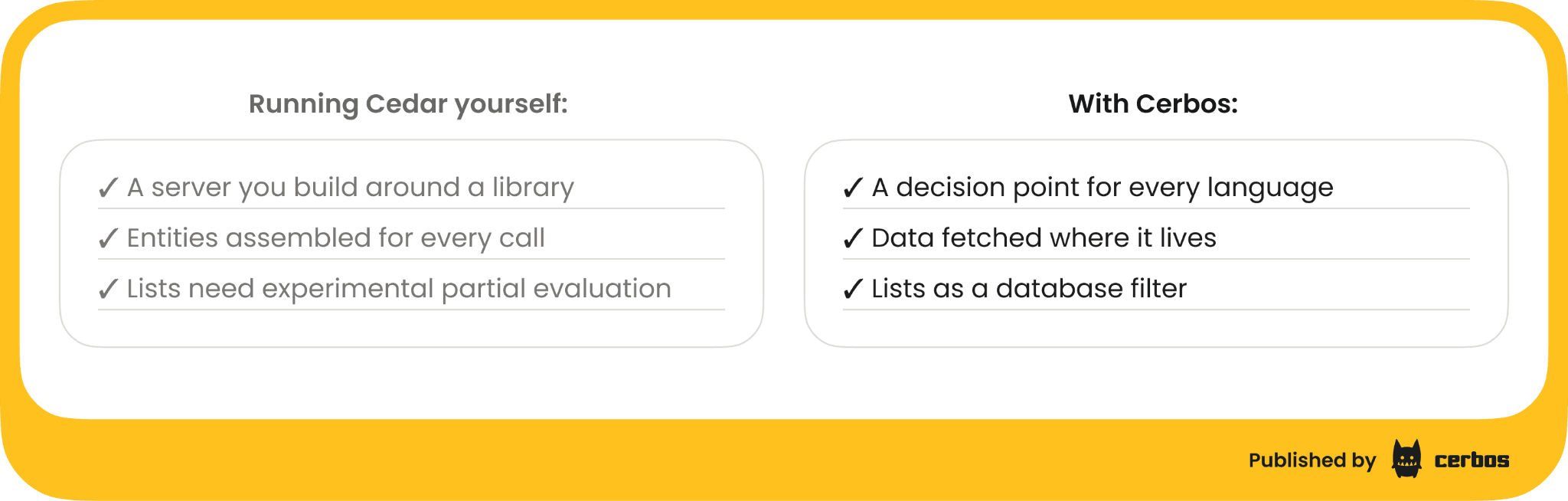
There is no official server. Cedar is a library you embed. The Cedar project's own agent library, cedar-local-agent, describes itself as a library customers can wrap in an HTTP server, is labeled experimental and was last released in April 2025 (Cedar repository, read November 2026). Each team builds the service, the policy loading and the distribution itself.
Every request carries all of its data. Cedar's documentation puts the caller in charge of providing every entity, parent and attribute a decision depends on. Each service that calls Cedar builds and maintains that data step.
Lists are hard. "What can this person see" needs partial evaluation, which evaluates a policy with the resource left open and returns the conditions a record must meet. Both Cedar's partial evaluation and its newer type-aware version are still experimental (Cedar changelog, read November 2026), and requests on Cedar's GitHub to filter data by permission have been open since 2024. One production team described on Cedar's GitHub in 2026 loading every user, record and relationship into memory to answer listing queries, and needing to re-architect to grow.
Decision logs are yours to build. The library returns the decision and the policies that determined it. Keeping, collecting and searching that record across services is left to each team.
The bindings differ. The reference engine is Rust. The Go implementation has no policy templates or partial evaluation, and there is no official Python binding, so a company with several stacks ends up with different capabilities in different services (cedar-go README and Cedar repository, read November 2026).
The language is small by design. No regular expressions, integer arithmetic only, no custom functions. Open requests ask for path types and separator-aware wildcards. A policy whose condition errors is also skipped, so a forbid that errors does not block (Cedar documentation, read November 2026).
Who needs a Cedar alternative, and how urgently
Teams about to embed Cedar in a second or third service have the cheapest moment to choose. The server, the data loading and the logging have not been built yet.
Teams building list views, search or AI retrieval need "what can this person see" now, and partial evaluation is still experimental.
Teams with an audit coming need decision logs that tie each access to the rule that allowed it, collected from every service, not reconstructed from application logs.
Teams with services in several languages feel the binding gaps first, and gain the most from one decision API every language calls.
Teams whose rules need more than Cedar's expressions hit the pattern and arithmetic limits as soon as file paths, topics, amounts or versions enter a rule.
A team with one service, a small policy set and no list, audit or second language on the horizon can wait. The time to choose is before the second service embeds Cedar, while there is still nothing to unwind.
What to look for in a Cedar alternative
- Is it a service or a library? A decision point your applications call in any language removes the per-stack binding question.
- Can the policy language express your rules? Check regular expressions, division, time windows, paths and hierarchies against a real rule from your product.
- What happens when a condition errors? An error should never let through access that a deny rule was written to block.
- How are lists answered? Look for a filter your own database runs, stable today, with adapters for the data layers you use.
- Where does the data come from? Ask whether the alternative can fetch attributes from your directory and databases at decision time, so services stop assembling entities.
- What can you show an auditor? Ask whether the alternative keeps each decision for you, with the request and the policy version, from every service, or whether each application has to log it as it does around the Cedar library.
- How do changes ship? Policy in Git, tests on every change, a build only when they pass, and rollback in one step.
For a full breakdown of what to look for when selecting an authorization solution - refer to our detailed framework.
The main types of Cedar alternative
Managed Cedar. AWS runs Cedar as Amazon Verified Permissions. You keep the language and lose the server work, but decisions run in AWS Regions, every request still carries its entities, and there is no call that lists what a person can see, only a batch check of up to 30 requests (AWS documentation, read October 2026).
Products built on Cedar. Several vendors embed Cedar in their own platforms or gateways. The language stays, and the data, logs and rollout become that vendor's design.
General purpose policy engines. These engines evaluate any JSON with a general language, and leave policy management, data and decision logs to you, as our Cerbos vs OPA comparison covers.
ReBAC (relationship-based access control) engines. Zanzibar-style engines store relationships as tuples and answer from that copy. They suit relationship graphs and add a second datastore to keep in sync, as PBAC vs Zanzibar explains.
Authorization management platforms. A platform runs the decision point next to every workload, manages, tests and distributes policy, fetches the data decisions need, and logs every decision. Cerbos is one.
Cerbos as a Cedar alternative
Policies in YAML and CEL, with the expressions Cedar leaves out
Cerbos policies are YAML with conditions in CEL, so a rule can use regular expressions, division, timestamps and durations, path functions and hierarchy functions in one condition. Derived roles name relationships such as owner or team member once for every rule, and variables and constants keep repeated logic in one place. A deny rule whose condition errors still denies.
One decision point for every language
Cerbos PDP runs as a service, a sidecar, a DaemonSet or inside AWS Lambda, next to each workload on any cloud, on-premise or a hybrid mix, all under one set of policies, and the embedded PDP evaluates in browsers, Node.js and edge runtimes. Official SDKs call the same API from every stack, so a Go service and a Python service get the same capabilities.
Lists from your own database, stable today
A query plan turns the policy into a filter your database runs, with adapters for Prisma, Drizzle, Mongoose, Convex, SQLAlchemy and LangChain with ChromaDB. The same policy answers the single check and the list.
Data fetched where it lives
Cerbos Synapse fetches attributes at decision time from SQL databases, identity providers such as Okta and Entra ID, and other stores through custom data sources, with caching set per source. Services send an ID instead of building an entity graph for every call.
Every decision logged with its policy version
Cerbos Hub gathers the decision logs from every decision point in one place, each tied to the policy version behind it, ready to filter by person, resource or action and to export, and each decision point can forward a copy to your SIEM. Cerbos itself has a SOC 2 Type II attestation.
Changes tested before they ship
Policies live in Git or Cerbos Hub policy stores with test suites beside them. Cerbos Hub runs the tests on every change, builds only what passes, shows which build each decision point runs and rolls back in one step.
One set of policies for apps, gateways, data and agents
Gateways such as Envoy and Istio, Trino's row and column filters, Kafka topics, MCP servers and AI agents all call the same policies your applications do. For an agent, Cerbos checks each tool call and its arguments before it runs, with the person behind the agent in the same request. Cerbos PDP and Cerbos Synapse implement the OpenID AuthZEN Authorization API, a standard whose working group Alex Olivier, our cofounder and CPO, co-chairs.
Cerbos in production at enterprise scale
Teams run more than 2 billion authorization checks a month on the Cerbos platform, and Utility Warehouse authorizes more than 4,500 services with it. Cerbos appears in the AuthZEN category of the Gartner® Hype Cycle™ for Digital Identity, 2026, and in KuppingerCole Leadership Compass reports on policy based access management, API security and management and generative AI defense, and more.
When Cedar may still fit
Some regulated teams have to prove that a revised policy set allows nothing the old one did not. Cedar Analysis, still experimental, is built for that proof on the policy text. The data, the lists, the decision logs and the rollout can still move to Cerbos.
Moving off Cedar without a big bang cutover
The policies are the quick part, since each permit and forbid has a direct Cerbos rule. The planning goes into where each entity's data should come from once services stop assembling it. Each service moves on its own. Its Cedar test cases become a Cerbos test suite, and Cerbos answers the same requests as Cedar, without enforcing, until the two agree. Our guide to migrating from Cedar to Cerbos walks through a full policy set with passing tests.
As Edgar Rivera, CTO at 4G Capital, put it, "It's quite easy to see what the policies do, and also very easy to update them. With the CI/CD feature you update a new policy and it automatically pushes latest version to the PDPs."
Try Cerbos with a rule your Cedar policies struggle to express. Your engineers get list views and search that respect permissions without hand-built partial evaluation, your identity team can change a group once and see it apply everywhere, and your security team gets the evidence for an audit without asking every service team for logs.
To plan the move from Cedar, book a call with our team, bring one service's Cedar policies, and leave with an order of services to move and the checks for each step.
Go deeper:
FAQ
Tagged in