Tech blog
Demos, implementation guides, product updates and broader takes on authorization, identity and security.

Why Cerbos doesn’t support role inheritance
Implementing role relationships in your Cerbos system.

The Secret Ingredients: protobufs and gRPC
Find out how Cerbos leverages protobuf and gRPC for defining all core features and interfaces.

Performance, Tracing, PHP SDK, Playground Updates - Cerbos v0.19 Release
The latest release of Cerbos, v0.19, includes performance improvements and tracing support, a new PHP SDK, Cerbos Maven Central releases and a number of UX updates to the Playground.

AWS Cognito + Cerbos - Fine-tuned Authorization for your FastAPI application
Learn how to set up AWS Cognito with your Cerbos + FastAPI application.

Tooling, Performance, .NET SDK, JS SDK, Playground - Cerbos v0.18 Release
The latest release of Cerbos, v0.18, includes performance and tooling improvements, a new .NET SDK, a major upgrade to the Javascript SDK, and the addition of viewing the Query Plan in the Playground.

File-based Audit Log, Wildcards, and Ruby SDK - Cerbos v0.17 Release
The latest release of Cerbos, v0.17, includes a new file-based audit logging backend, wildcard role support, and a new Ruby SDK.

Using AWS Cognito with Cerbos
Learn how to integrate your users and roles in AWS Cognito with Cerbos for powerful, fine-grained access control.

GitHub’s inconsistent access control
GitHub’s repository settings page suffers from a frustrating anti-pattern where policies are not enforced consistently - there’s a better way to keep access control rules consistent between layers and decouple policies from code.

Unified API, Query Plan GA, Python and Rust SDKs - Cerbos v0.16 Release
The latest release of Cerbos, v0.16, includes a new unified API for checking permissions, promotion of the Query Plan to GA, and several updates to the REPL - also Cerbos Python and Rust SDKs have been released.

REPL, IDE Support, Testing and more - Cerbos v0.15 Release
The latest release of Cerbos includes a new REPL for developing conditions for policies, rich IDE support for a better authoring experience and improvements to the testing framework.

Using Clerk with Cerbos
Clerk solves user management so developers can stop reinventing the wheel and focus on their core business - the same mission Cerbos has for authorization

Understanding Context-Aware Permissions
Context-aware permissions (CAP) promote anywhere-anytime access by making computers intelligent enough to sense and react to their environment. You can use CAP in your software to define who needs access to what information at what time, so that your users can access only the information and services they need based on their location, the time of day, or other context factors.
Recommended content
Mapping business requirements to authorization policy
eBook: Zero Trust for AI, securing MCP servers
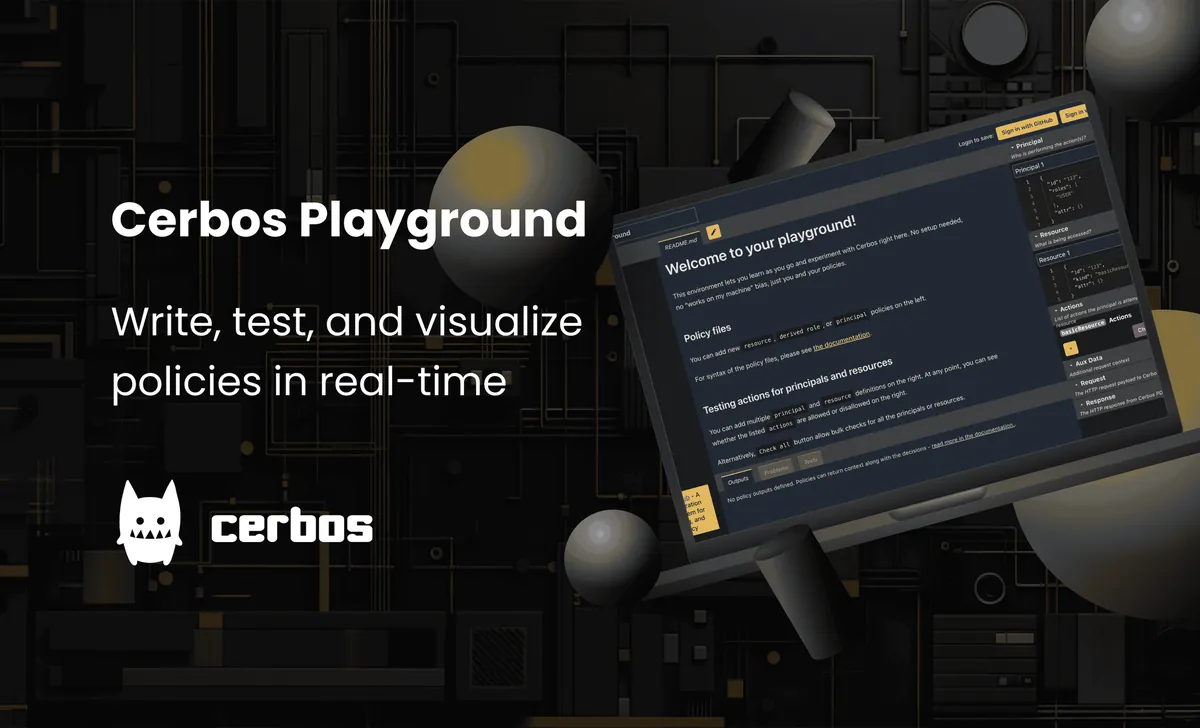
Experiment, learn, and prototype with Cerbos Playground
eBook: How to adopt externalized authorization

Framework for evaluating authorization providers and solutions