If you are looking for a SpiceDB alternative, you probably have SpiceDB running already, or you are close to choosing it. You modeled permissions as definitions, relations and permissions, the way Google's Zanzibar paper describes, and checks work. What grows is everything around the engine. A datastore to run, a tuple to write every time a fact changes in your own database, caveats that need context on every call, a leaver whose tuples someone has to remember to delete, and a security team asking which rule allowed an access.
SpiceDB is AuthZed's open source implementation of the Zanzibar model, also sold as a self-hosted enterprise edition and as hosted and dedicated cloud services. Whichever edition you run, the copy of your relationship data it answers from is yours to keep in sync, and that is usually what sends teams looking.
Why teams look for a SpiceDB alternative
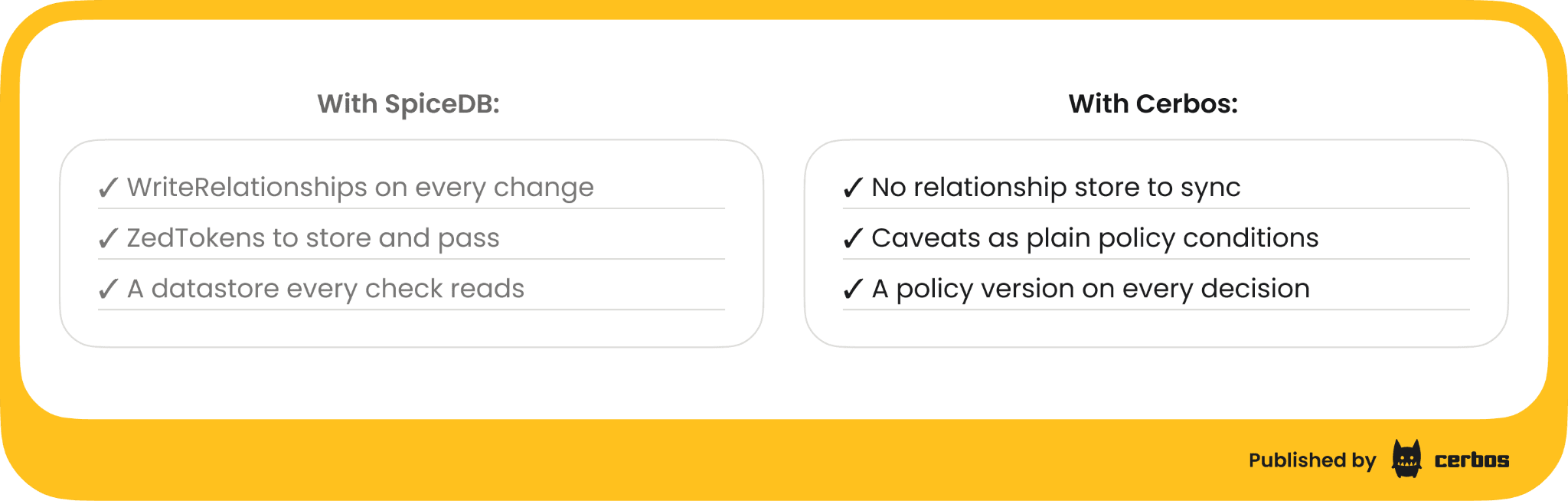
Keeping two copies of the same data. SpiceDB answers from relationships it holds, so every assignment, share and deletion in your database has to be written to SpiceDB too. Nothing spans the two writes, so a failure between them leaves them disagreeing. AuthZed's own writing on the dual write problem calls it difficult to solve and lists six approaches, from doing nothing to periodic consistency checks, an outbox table, event sourcing or durable execution, or making SpiceDB the only source of truth (January 2025). Apart from doing nothing, each one is a system to build.
Running a stateful service. Self-hosted SpiceDB needs a datastore, and AuthZed's docs recommend CockroachDB for multi-region and high throughput, Spanner on Google Cloud and Postgres for a single region (October 2026). That database is read by every check, so it has to be highly available, and moving between datastores has to go through SpiceDB's own export and import, not a database dump.
Rules that mix relationships and attributes. SpiceDB adds attribute rules through caveats, CEL expressions attached to relationships, with context either stored on the relationship or sent with each check. When required context is missing, a check returns a conditional result that your application has to handle. Rules about amounts, regions, status and time end up split between the schema, the stored context and the calling code.
Consistency the application has to manage. Freshness in SpiceDB is controlled with ZedTokens and consistency modes, and the docs warn that relying only on the default can return stale results after a change. Storing and passing tokens correctly becomes part of every feature that writes permissions.
Audit and evidence. A security team wants to know which rule allowed a request, and with which inputs. Open source SpiceDB records relationships and their changes, and AuthZed’s Cloud, Dedicated and Enterprise editions add an audit log of each API call. A security team that wants one trail across applications, gateways, data platforms and agent tool calls still has to join those logs with the logs from every other system that makes access decisions.
Coverage beyond the application. SpiceDB answers the applications that call its API. Gateways, data platforms and AI agents each need their own integration work, which can mean running a second policy engine beside SpiceDB.
Who needs a SpiceDB alternative, and how urgently
Teams about to adopt SpiceDB have the cheapest move available. Before any tuple is written, the decision is only about which model fits your rules and how much infrastructure you want to own.
Teams whose sync pipeline is growing. If every new feature adds tuple writes, deletes need custom cascades, or you are building an outbox or change data capture job just for SpiceDB, the cost will keep rising with the product. Moving earlier means fewer write paths to unpick.
Teams facing an audit or a regulator. If you need to show which policy allowed an access and you are reconstructing it from relationship history, a platform with decision logs closes that gap before the next review.
Teams adding AI agents. An agent's tool call needs the agent's identity, the person behind it and the call's arguments in one decision. That is a policy question, and the sooner it shares a model with the rest of authorization, the fewer systems the security team has to approve.
What to look for in a SpiceDB alternative
- Where does the data behind a decision live? Ask whether the alternative needs its own copy of your relationships, or can read them where they already are. A second copy means a second write path and a sync problem, whichever product holds it.
- Can one rule combine a relationship with attributes? Owner, team and folder access almost always come with conditions on status, region, amount or time. Look for both in the same readable rule, not one in a schema and the other in calling code.
- How are lists answered? Search, dashboards and AI retrieval need "everything this person can see". Check whether the answer comes back as IDs your application then loads, or as a filter your own database runs with its usual sorting and paging.
- What can you show an auditor? Look for a log of every decision with its inputs and the policy version behind it, collected from every service into one place.
- How do rules change and roll back? A rule change should be reviewable, tested before it deploys and reversible in one step, without migrating data.
- Does it cover more than applications? Gateways, service meshes, data platforms and AI agents should use the same policies and the same audit trail.
- Is there a standard API? The OpenID AuthZEN Authorization API standardizes how applications and gateways ask for a decision, which limits lock in.
For a full breakdown of what to look for when selecting an authorization solution - refer to our detailed framework.
The main types of SpiceDB alternative
Other Zanzibar-style ReBAC engines. They share SpiceDB's model, tuples in their own store, followed through a schema. Moving between them changes the schema language and the API, but not the dual write, the consistency tokens or the operations. Our Cerbos vs OpenFGA comparison covers OpenFGA in detail.
Hosted authorization services. The vendor runs the engine and the store. That removes the database from your list, but the sync remains, now into someone else's cloud, and each check becomes a call to it.
General purpose policy engines. They evaluate rules against input you send and keep no relationship store. They leave policy management, distribution, testing workflows, decision logs and data fetching for your team to build.
Building on your own database. Some teams replace the engine with queries on their own tables. It removes the sync, but authorization logic spreads back into application code, with no central policy, tests or decision logs.
Authorization management platforms. A platform evaluates policies against data where it already lives, fetches what the application does not send, manages policy testing and rollout, and logs every decision. Cerbos is one.
Cerbos as a SpiceDB alternative
Cerbos models relationships as derived roles, granted when a condition about the person and the resource is true, and evaluates them in the same policy as attributes, against relationship data read from the systems that own it.
Decisions from your own data instead of WriteRelationships
Cerbos PDP is a stateless decision point that holds policy and nothing else. The application sends the attributes it has already loaded, and Cerbos Synapse fetches the rest at decision time, from SQL databases through its built-in data source, from identity providers such as Okta and Entra ID, and from any other store, a graph database included, through a custom data source. There is no second copy, so the dual write, the outbox and the consistency tokens all go. We cover the pattern in reading authorization attributes from the database.
SpiceDB caveats and relationships in one Cerbos policy
Owner, editor, team member and folder viewer are derived roles. Status, region, amount, IP range and time are CEL conditions in the same rule, the same expression language SpiceDB caveats use. An expiring share is a timestamp checked against now(), and a public document is a flag, not a wildcard tuple.
Query plans in place of LookupResources
A query plan turns the policy into a filter your database runs, so "everything this person can see" comes back sorted and paginated as usual. Adapters cover Prisma, Drizzle, Mongoose, Convex, SQLAlchemy and LangChain with ChromaDB for retrieval.
Decision logs tied to a policy version
Every decision is logged with its inputs, outcome and the policy version behind it. Cerbos Hub collects the logs from every decision point into one searchable trail, and exports them to your SIEM. Cerbos holds a SOC 2 Type II attestation.
Rule changes that are tested and reversible
Policies are YAML that security and identity reviewers can read in a pull request, with test suites beside them. Every change runs its tests in Cerbos Hub before it can deploy, you can see which build each decision point runs, and a bad build rolls back in one step. A rule that needs a new fact reads it from the system that holds it, not from a backfill.
Gateways, data platforms and agents under the same Cerbos policies
The same policies cover Envoy and Istio through Cerbos Synapse, Kong, Apigee and other gateways through the Cerbos API or AuthZEN, Trino row and column filtering, Kafka topics, MCP servers and AI agents, whose tool calls are checked down to their arguments with the agent's and the person's tokens in the same request. Cerbos PDP and Cerbos Synapse implement the AuthZEN Authorization API. Alex Olivier, our cofounder and CPO, co-chairs the AuthZEN Working Group.
Proven at scale
The Cerbos platform runs more than 2 billion authorization checks a month, and Utility Warehouse uses it across more than 4,500 services and thousands of non-human identities, with millions of access decisions a day. Analysts follow the category as well. Cerbos is included in the AuthZEN category of the Gartner® Hype Cycle™ for Digital Identity, 2026, and in KuppingerCole Leadership Compass reports on policy based access management, API security and management and generative AI defense.
When Cerbos is not the right SpiceDB alternative
If your product depends on LookupSubjects, SpiceDB’s “who can access this” lookup, across a very large, constantly changing sharing graph, measure that path on your own data first. Attribute rules, gateways, agents and audit can still move to Cerbos, with Cerbos Synapse reading the graph where it lives.
Moving off SpiceDB without a big bang cutover
Most of a move off SpiceDB is data. Export the relationships once, find where each kind of tuple's fact already lives, usually a column in your database or a group in your identity provider, and give a table to the few that only ever lived in SpiceDB. Definitions become derived roles and rules, caveats become CEL conditions, CheckPermission becomes a Cerbos check and LookupResources becomes a query plan. Teams move one resource type at a time and run Cerbos beside SpiceDB on the same requests until every decision matches. Our SpiceDB migration guide works through a full schema with passing tests.
As David Workman, Senior Software Engineer at Salesroom, put it, "With Cerbos, non-engineers can write, update, and audit policies, which frees up our engineers for other important tasks."
Try Cerbos with one of your own SpiceDB definitions. Your engineers keep one database and one write path, your identity team sees directory changes reach decisions within the cache time they set, and your security team can show an auditor which policy allowed each access.
To plan the move from SpiceDB, book a call with our team, bring a schema and we will go through which tuples your own systems already hold.
Go deeper:
FAQ
Tagged in