Most enterprise teams reach a point where authentication is handled. You've rolled out Okta SSO across the organization, MFA is enforced, lifecycle management runs through Okta Workflows, and federation with your other identity sources is stable. The identity layer is solid.
Then someone asks a question Okta can't answer. Not "who is this person?" but "can this person do this specific thing, to this specific resource, right now?"
That's authorization. And it's where the gap starts to show.
What Okta actually covers
Okta is built to solve authentication and identity management. It verifies credentials, issues tokens, manages user directories, handles federation across identity sources, and runs the joiner-mover-leaver lifecycle through Workflows. It does this well, and most enterprise teams who have invested in Okta are right to keep it as the identity foundation.
Okta also offers some authorization features. Group memberships flow into token claims, custom claims can carry attributes, and Okta Identity Engine policies can gate access at sign-in. For straightforward use cases, a small set of static roles, a few enterprise apps behind SSO, this is enough.
Okta also offers Auth0 FGA, a fine-grained authorization product based on Google's Zanzibar paper and built on the Auth0 FGA codebase. FGA is good at relationship-based access (ReBAC), the "user owns folder, folder contains document, share via collaborator" pattern that companies like Google Drive solved with Zanzibar internally. If your authorization model is fundamentally about object relationships, FGA fits.
What FGA does not solve is attribute-based decisions against arbitrary runtime context, policy-as-code workflows that fit into CI/CD, tenant-scoped policy customization for SaaS, or readable policies that auditors and product managers can review. Those are different problems, and they're the ones most enterprise teams hit once they're past the early stages.
Broken access control has been the number one vulnerability in the OWASP Top 10 since 2021. The gap between "we handle login through Okta" and "we control access properly across our applications" is where most of that risk lives.
Where the gap appears
The authorization capabilities Okta offers tend to break down along a few predictable lines.
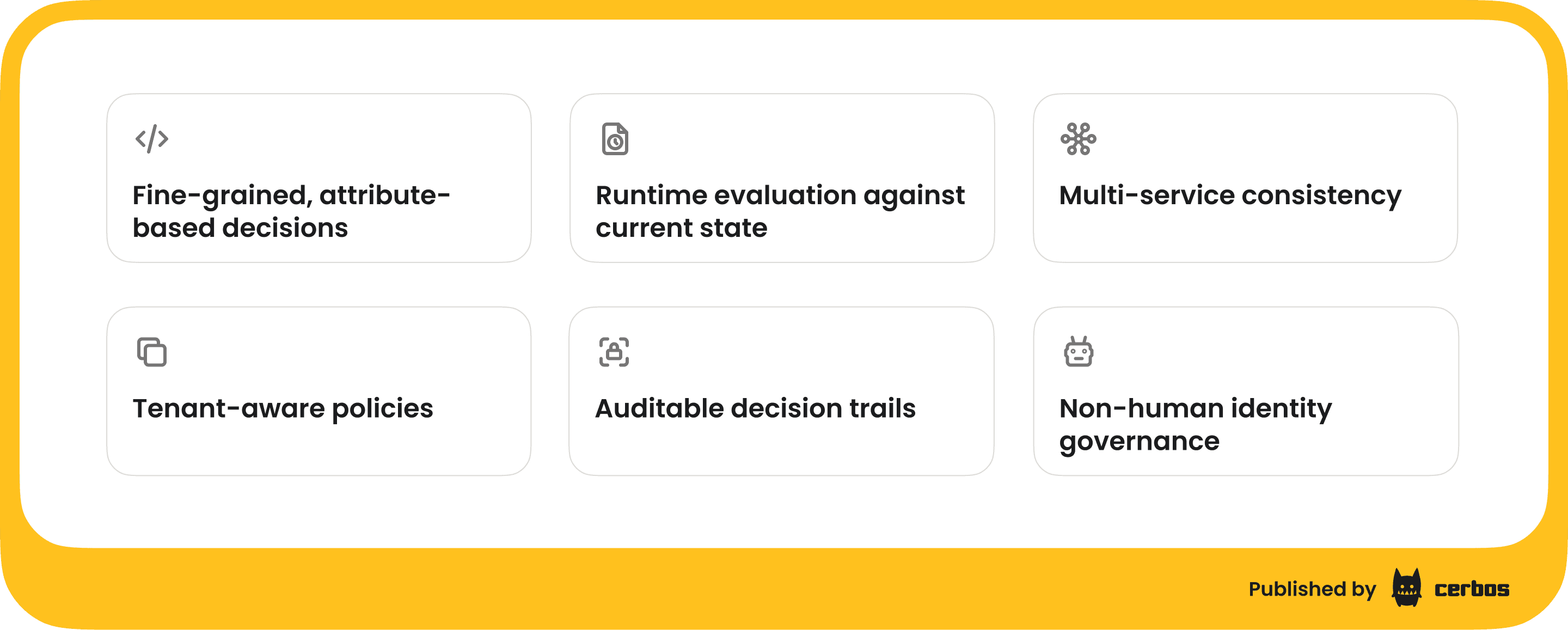
Fine-grained, attribute-based decisions
Okta can tell you that someone is in the "editors" group, and that group membership can flow into a token claim. It cannot evaluate whether that editor should access a specific document based on its classification level, the editor's department, the time of day, and the document owner's relationship to the editor, all in a single check. These multi-attribute, contextual decisions are what real applications need once you're past the early stages. NIST formalized this as Attribute Based Access Control in SP 800-162, establishing that access decisions should evaluate attributes of subject, object, action, and environment together.
Okta FGA addresses some of this through relationships, but it's still object-centric. It does not give you a general policy engine that can take any attribute, from any source, and use it in a decision.
Runtime evaluation against current state
Okta-issued tokens carry a snapshot of group memberships and claims at the moment of issuance. But context changes between token issuance and the moment a user takes an action. A resource gets reclassified. A user changes departments and the Okta sync hasn't run yet. A tenant updates their configuration. If your access decisions are frozen in the token, they're stale.
Increasing token refresh frequency helps, but it does not solve the underlying problem. You still need a decision point that evaluates against current state, not cached claims.
Multi-service consistency
When authorization logic is embedded in each application, you end up with different teams implementing the same rules differently. One service checks roles from the Okta token. Another queries a database. A third has permissions hardcoded in middleware. The result is drift, inconsistency, and a maintenance burden that grows with every service you add. As one commenter put it in a popular Hacker News discussion on distributed authorization, the industry has "a very frustratingly uneven set of solutions for authorization." Authorization policy should be defined once and reused everywhere, not copied, reimplemented, or reverse-engineered from code during an audit.
Tenant-aware policies
SaaS products almost always need different authorization rules per tenant. Enterprise customers expect to define custom roles, restrict actions, or scope visibility in ways that don't affect other tenants. Okta groups can be scoped per tenant, but Okta itself does not have a concept of tenant-scoped authorization policies that customize what actions are allowed in your application. Teams build it themselves, and it becomes the kind of technical debt that quietly consumes sprints for years. At NTWRK, managing edge case policies across a distributed architecture became untenable until they moved to externalized, centralized policy management that handled tenant-specific rules without duplicating infrastructure.
Auditable decision trails
Compliance frameworks like SOC 2, HIPAA, and PCI DSS don't just require access controls. They require evidence of how access decisions were made, which policy was in effect, what attributes were evaluated, and why a request was allowed or denied. Okta's system log captures authentication events and admin changes well. But a common audit finding is that companies log authentication events while missing authorization decisions entirely. When an auditor asks "why did this user have access to this resource on this date?", you need to reconstruct the exact authorization decision, not just confirm they were logged in through Okta. With the average data breach costing $4.88 million in 2024 and $6.08 million in financial services, the evidence trail isn't optional.
Non-human identity governance
Microservices, AI agents, batch jobs, and third-party integrations all make requests that require authorization. They don't authenticate the way humans do, and the Okta-centric model wasn't built with them in mind. Okta has service accounts and OAuth client credentials, but those handle authentication for the machine identity. The policy decision about what that machine can do, to which resource, under which conditions, still has to live somewhere. As organizations deploy more machine identities, the need for a purpose-built authorization layer that governs human and non-human actors consistently becomes hard to ignore.
Recognizing the decision point
None of this means you need to rip anything out. Okta remains the right system for managing identities, running SSO, and handling authentication. The question is whether you also need a dedicated authorization layer, separate from Okta, that handles the access decision side.
A few signals that you're at that point:
| Signal you need a dedicated authorization layer | Details |
|---|---|
| 1. Permission changes require code changes | If updating who can do what means editing application code, recompiling, testing, and redeploying, you've coupled authorization to your release cycle. That coupling gets expensive. At Human Managed, permission modifications used to require source code changes and full redeployment. After externalizing authorization, the same changes became a five-minute task. |
| 2. Multiple services implement the same rules independently | If your checkout service, your admin dashboard, and your API gateway all have their own authorization implementations, you're maintaining N copies of logic that should live in one place. |
| 3. Compliance prep is a scramble | If getting audit-ready means manually collecting evidence from Okta, your application database, your service logs, and your code repository to demonstrate who had access to what, you don't have centralized authorization visibility. |
| 4. Role explosion is making things harder, not easier | If your Okta groups and your application roles have grown from a handful to dozens or hundreds (or if you have more roles than employees!), and you're creating new ones to handle edge cases rather than solving the underlying model problem, the complexity will only accelerate. |
| 5. Your team spends real engineering time on permissions | Authorization work is risky, detail-oriented, and rarely the kind of thing that excites engineers. An IDC study found that developers spend 19% of their weekly hours on security-related tasks, effectively costing organizations $28,000 per developer per year. If a meaningful chunk of that time is going to authorization logic, that's sprint capacity that isn't going to product features. |
How to evaluate and shortlist authorization solutions
Once you've identified the gap, the next step is evaluating solutions with a structured approach rather than a feature-by-feature comparison. We published a detailed evaluation framework covering nine dimensions that enterprise teams should consider. Here are the ones that matter most when you're shortlisting alongside Okta SSO.
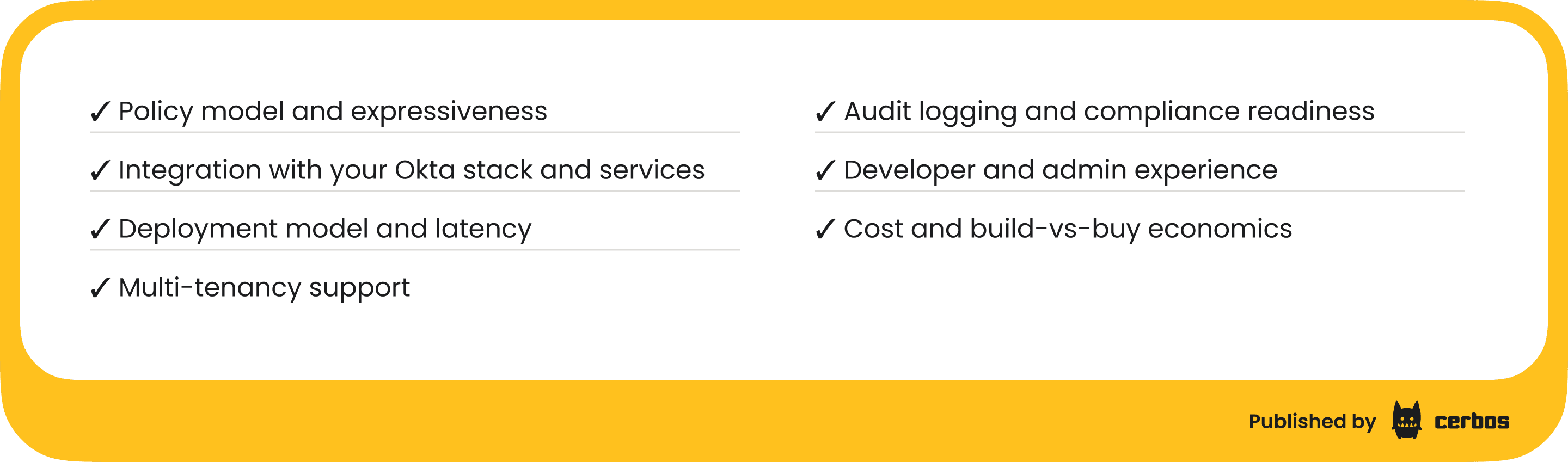
Policy model and expressiveness. Can the solution support RBAC, ABAC, and policy-based access control? Can you express conditions using attributes of the user, the resource, and the context of the request? Solutions that only support role-based checks will hit the same ceiling Okta groups already hit. Look for a policy language that's readable by people outside engineering. When auditors, product managers, or security leads need to understand the rules, a purpose-built policy language in YAML or a similar declarative format is more practical than a general-purpose programming language.
Integration with your Okta stack and services. The authorization layer should consume identity context from Okta without replacing it. It should accept Okta-issued tokens, read group claims, work with your token format and directory structure, and fit your deployment model. Check for SDKs in the languages your team uses and APIs that fit your architecture, whether that's REST, gRPC, or both. An authorization solution that requires you to change how you handle identity through Okta is solving the wrong problem.
Deployment model and latency. Authorization is on the critical path of every request. Latency matters. A solution that adds tens of milliseconds per check will degrade user experience at scale. Look for architectures where the decision engine runs close to your application, ideally as a sidecar or within the same cluster, with in-memory evaluation and sub-millisecond response times. Stateless designs that allow horizontal scaling without shared state are easier to operate in production.
Multi-tenancy support. If you're building SaaS on top of Okta, evaluate how the solution handles per-tenant policy customization. Can you scope policies to individual tenants without duplicating your entire policy set? Can tenants have different roles, different rules, different access models without affecting each other? This is where many generic authorization tools fall short, and it's not something Okta groups solve on their own.
Audit logging and compliance readiness. Every authorization decision should be logged with enough context to reconstruct it later. That means the requesting principal, the action, the resource, the decision, and the policy version that was evaluated. Look for structured log formats that integrate with your SIEM, configurable retention, and the ability to correlate authorization decisions with application events. Cerbos Hub, for example, provides structured audit logs meeting SOC 2, ISO 27001, HIPAA, PCI DSS, and GDPR requirements, including a unique correlation ID (cerbosCallId) that links authorization decisions back to the originating application request.
Developer and admin experience. The learning curve matters. Solutions that require weeks of ramp-up before a developer can write a policy will face adoption resistance. Look for policy-as-code workflows with version control, testing and simulation tools, and a clear local development story. The ability for non-developers to understand and even modify policies, through a UI or readable policy files, reduces the engineering bottleneck over time. One enterprise team described their experience as taking a few days to understand the system and a couple of weeks to reach production.
Cost and build-vs-buy economics. One recurring pattern is teams underestimating the total cost of building authorization in-house. The initial implementation looks manageable. Then comes multi-tenancy, then audit requirements, then the second and third service, then policy versioning, then the engineer who built it leaves. A realistic build-vs-buy analysis should account for ongoing maintenance, not just initial development. One company estimated the lifetime cost of their in-house approach at seven figures. Another startup scoped the development cost alone at GBP 200,000 before exploring external options.
Running a proof of concept
Before committing, run a focused POC against one real service. Not a demo app, an actual service in your stack with real users and real authorization requirements.
Define what success looks like up front. Can the solution model your existing Okta groups and application permissions accurately? Does it handle the edge cases your team currently hardcodes around? What's the latency overhead under realistic load? Can a new developer write a policy without hand-holding?
Involve more than just the engineering team. Have your security lead review the audit output. Have a product manager read the policies. Have your identity team confirm the integration with Okta is clean. If the solution only makes sense to the person who configured it, adoption will stall.
The bigger picture
Authentication and authorization solve fundamentally different problems. Authentication has been successfully decoupled from applications for years, and the industry is better for it. Okta is the proof point at enterprise scale. Authorization is following the same trajectory.
There's a reason a Hacker News thread titled "Why Authorization Is Hard" drew over 300 upvotes and dozens of engineers sharing war stories. This is a problem most teams eventually hit, and the tooling to solve it properly is maturing. The OpenID Foundation's AuthZEN specification, ratified in January 2026, is formalizing the interface between enforcement points and decision points, much like OAuth and OIDC standardized authentication.
Okta handles identity. A dedicated authorization layer handles access decisions. Together they form a complete access control architecture. The teams that recognize this gap early, before compliance pressure or scale forces their hand, are the ones that avoid the painful migration later.
Try Cerbos Hub to see how externalized authorization works alongside Okta SSO, or book a call to talk through your architecture with our engineers.
Go deeper: How to adopt externalized authorization (eBook) for a step-by-step playbook on decoupling authorization from application code.
FAQ
Tagged in