At KuppingerCole's pre-conference workshop at EIC Berlin 2026, the hosts asked the room who was taking inventory of the agents running in their organization. The show of hands was, by their estimate, about two percent of the audience. The same workshop's list of shifts still to be reckoned with named the agent CMDB as foundational governance infrastructure, and it is not hard to see why. Every other control in AI identity and access management, a sponsor, an expiring credential, a per-action policy, presumes you know the agent exists. Two percent of the room did.
An agent CMDB, or agent registry, is where that inventory lives. Discovery tooling does not give you one, and even a complete registry is the input to governance rather than the governance itself. This piece is part of our series on AI identity and access management, which starts with what AIAM is.
What is an agent CMDB?
An agent CMDB is the system of record for every AI agent an organization runs. It holds a unique identifier for each agent and each running instance, the agent's version and the model and code it is built on, its named human sponsor and technical owner, its purpose and risk tier, the systems and tools it is permitted to reach, its lifecycle state, and the runtime identities bound to it. Like a configuration management database for infrastructure, it exists so that every other process, from credential issuance to authorization to incident response, can look up an authoritative answer about what an agent is and who is accountable for it.
Registry and CMDB are used for the same thing in this space. The Coalition for Secure AI calls it the agent registry that acts as the system of record. The EIC workshop called it the agent CMDB. Gartner's concept of operation for agent IAM, presented at Gartner IAM London 2026, draws it as the AI agent registry that identification, registration, and ownership assignment all flow through.
You cannot govern an agent you have not found
The reason inventory comes first is not a matter of tidiness. Kuppinger's answer to the closing question at EIC, what the most practical first step is toward coherent governance, had two parts, and the first was discovery. We cannot protect what we do not know. Jonathan Care of KuppingerCole put it at the top of his three things to remember if you forget everything else. Inventory beats everything else, and if you have not done it, it is probably worse than you think.
Every framework that has tried to sequence agent governance puts discovery first. The CoSAI adoption model's first phase is visibility, discover and register all agents as identities and eliminate shared accounts, with the stated outcome that no agent sits outside the identity perimeter. The OWASP State of Agentic AI Security and Governance report's maturity model begins at step zero with discovering shadow AI before anything else is assessed. Care's 90-day plan spends its entire first month on inventory, tagging every non-human identity with a human owner and identifying the top ten percent by privilege as the blast radius. Homan Farahmand of Gartner said at IAM London that uniquely identifying and registering AI agents is foundational to securing access management and accountability.
The practical version is the rule the EIC workshop put on its starting-Monday list. Require agent registration before any API access. An agent that is not in the CMDB does not get a credential, does not pass a policy check, and does not reach a tool. That single default turns the registry from a spreadsheet into a control, and it is the subject of our companion piece on shadow agents.
Discovery is not inventory
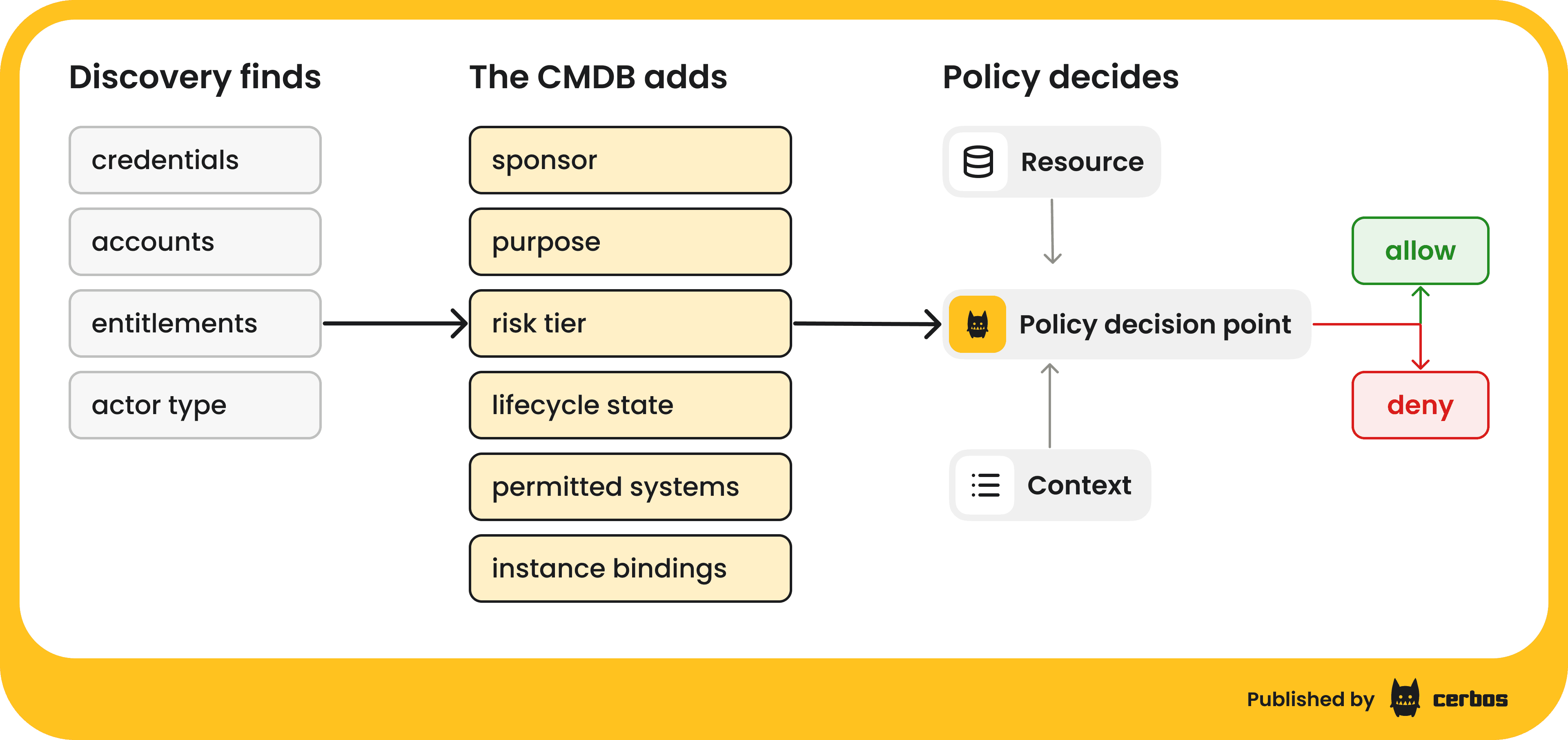
There is a trap here that identity teams will recognize from human identity programs, and Nathan Harris of Gartner named it precisely at IAM London. Discovery tooling can find credentials, managed and unmanaged, accounts, assigned entitlements, the actor type behind an identity, and which humans are interacting with which machine accounts. What discovery only partially finds is the ownership of a machine identity and the link between an account and an identity. What it cannot find at all is the identity's purpose, its intent, its authorized business role, or a full digital identity for the actor. Those come from somewhere else, or they do not exist.
That gap is the difference between a scan and a CMDB. A scan tells you there are four hundred service principals with API keys. A CMDB tells you which of them are agents, who sponsors each one, what each is for, and whether it is still supposed to be running. Matthias Reinwarth of KuppingerCole added the operational nuance at EIC when an audience member objected that a central registry is always behind in a real mesh where agents spawn sub-agents at runtime. His answer was to separate the logical registry, the single view across everything, from the physical registries that each platform maintains. Putting everything in one repository is a different thing from having a logical view across several, and the second is achievable.
No scan captures what an agent is for. Nat Sakimura of the OpenID Foundation made the point at EIC that an agent card, the self-description an agent publishes about its capabilities, is metadata and not governance. A self-asserted card is advertising. Registration is where a human states what the agent is for, who is accountable for it, and what it may reach, and where that statement is attested rather than claimed.
What belongs in the record
The CoSAI paper specifies the registry's contents in its governance appendix, and it is a good baseline. Agent identifiers and versions. The allowed runtime identities and bindings, the SPIFFE identities, certificates, or tokens the agent is permitted to present. Lifecycle state, active, revoked, or deprecated. Ownership and contact information. Capability and risk tier classification. Provisioning, rotation, and decommissioning events recorded against the entry so the record is a history and not a snapshot.
Two additions come from practice. Uber's security engineering team described in Solving the Identity Crisis for AI Agents how their agent registry stores the association between an agent and the workload it is authorized to run on, and how their security token service consults that registry before minting any token, refusing to issue one to a workload that is not registered to host the agent it claims to be. The registry is checked at mint time, not at audit time. The second addition is the instance. A record per agent class is a start. A record that can resolve which running instance presented which credential is what an incident review needs, and it is the level the CoSAI reference patterns reserve for agents touching sensitive or regulated data.
The register-before-access rule needs one more field to work, which is the set of systems and tools the agent is permitted to reach. Without it, registration confirms that the agent exists and says nothing about whether the call it is making is one it should make. With it, the record is something a policy can evaluate.
The CMDB is the input. The policy is the enforcement.
An agent CMDB is a system of record, and a record is not a control. It becomes one when something consumes it at the moment an agent acts. This is the same split that runs through every part of AIAM, and the CMDB is where it is easiest to see, because the failure mode is so familiar. Every organization has a CMDB for servers that is out of date, ignored by the deployment pipeline, and consulted only after the incident. A CMDB nobody reads at runtime is documentation.
The alternative is to make the registry an input to every decision. At credential issuance, the token service checks the registry before minting, as Uber's does. At each action, the authorization decision reads the agent's registry state, its sponsor, its risk tier, and its permitted systems, and denies if the agent is unregistered, deprecated, or reaching for something its record does not allow. At review, the registry is what policy recertification is checked against. Sakimura's line covers the whole progression. Identification is not trust, discovery is not authority, and metadata is not accountability. Each step is a necessary input to the next, and none of them is the decision.
Kuppinger's second practical starting point at EIC was access to the resources. Do as much and as good in authorization as you can in front of the resources, because it is a control point you can get a grip on. Discovery and the registry give that control point something to decide with.
How Cerbos fits
Your registry owns the record, whether it is an extension of your identity governance platform, a workload identity management tool, or a purpose-built agent registry. The Cerbos authorization management platform is where the record becomes enforcement. Every call an agent makes is evaluated by the Cerbos PDP, the policy decision point, against policy that can require the agent to exist in the registry, to be in an active lifecycle state, to have a current sponsor, and to be reaching a system its record permits. An unregistered agent matches no policy and is denied, which is how register-before-access becomes a rule that runs on every request rather than a line in a standard.
Cerbos Synapse is the piece that reads the registry. It fetches the agent's CMDB entry, its sponsor's status in the directory, and its relationships from your systems at decision time and delivers a fully enriched request to the engine, so the policy reasons about the authoritative record rather than about claims the agent makes for itself. Policies are YAML with CEL conditions, so a rule that says deny unless registry state is active and the target system is in the agent's permitted list is a few lines. Every decision is written to the audit log with the agent, its registry attributes, the action, and the policy version, which gives the registry the runtime history that turns a snapshot into a record. The same model governs every non-human identity you have registered, and the AuthZEN standard means the decision is portable across whatever registry you choose.
Two percent of the room had an inventory. The rest were governing agents they could not see, which is to say they were not governing them. Build the CMDB, make registration the price of a first API call, and then make sure the record is read on every request and not only after the incident.
Try Cerbos to see your agent registry checked on every request an agent makes, or book a call to talk through your agent inventory with our team.
The full AIAM series:
FAQ
Tagged in