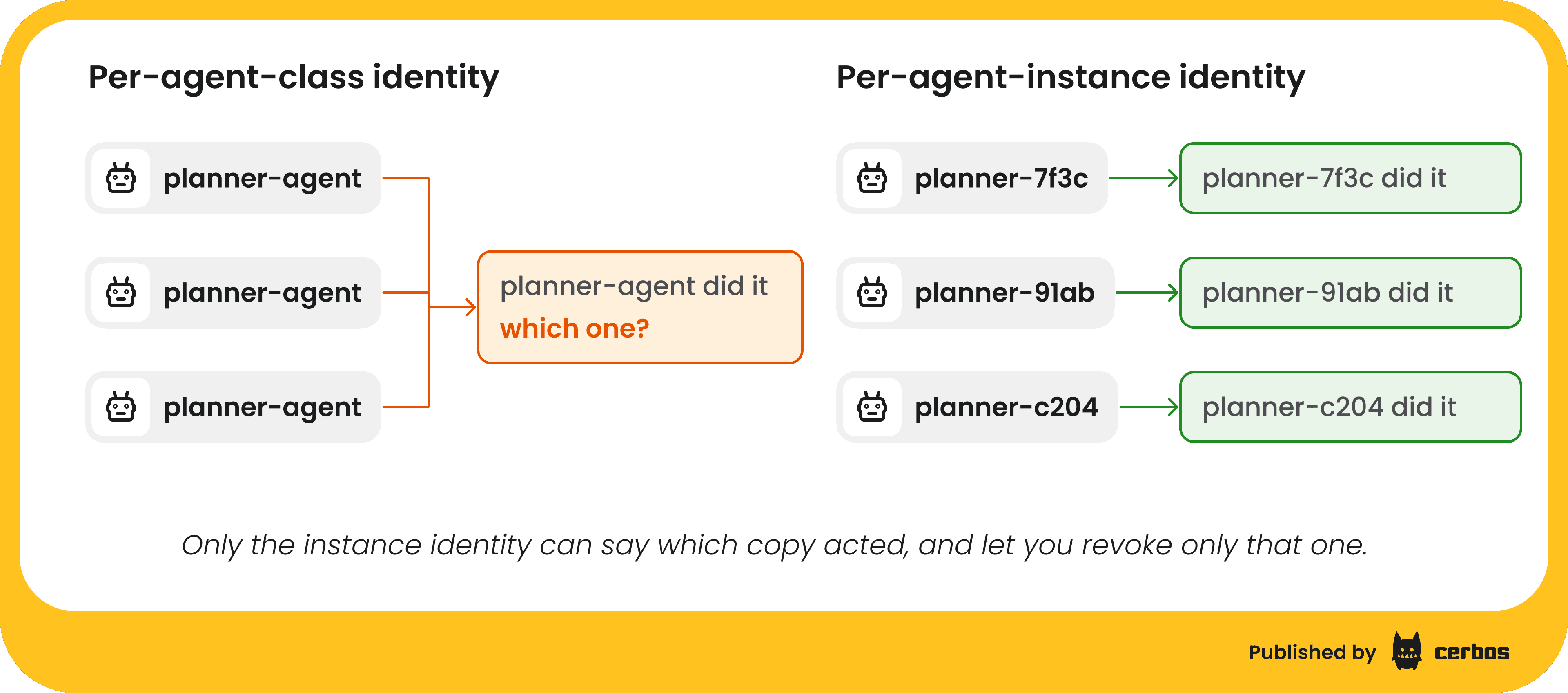
Two copies of the same agent get the same prompt and take different actions. That is not a bug. It is how a non-deterministic system behaves, and it is the reason a single identity shared across every running copy of an agent cannot tell you who did what. When something goes wrong, the audit log says the planner agent did it. Which planner, on which node, under whose delegation, at which minute, is the question an incident review actually asks, and a class-level identity has no answer.
The industry is converging on identity per agent instance, and it only pays off once the authorization layer uses it. This piece is part of our series on AI identity and access management, which starts with what AIAM is and follows the AIAM lifecycle one stage at a time, from registration to revocation.
What is per-agent-instance identity?
Per-agent-instance identity is the practice of giving each running copy of an AI agent its own distinct, verifiable identity, rather than sharing one identity across every instance of that agent type. The instance identity is bound to the specific runtime that is executing, can be issued, rotated, and revoked independently, and is carried into every action the instance takes so that audit, delegation, and policy can refer to the exact actor rather than to its class.
The contrast is a per-agent-class identity, one client_id, service account, or bot credential that every instance of a given agent presents. The class tells you what kind of thing acted. The instance tells you which one.
Why a class identity cannot answer who acted
Jonathan Care of KuppingerCole put identity per agent instance, not per class, at the top of the eight-question vendor checklist he presented at EIC Berlin 2026. One identity per instance, issued, rotated, and revoked. The reasoning is that everything downstream depends on it. You cannot revoke one misbehaving copy if all copies share a credential. You cannot narrow one instance's scope without narrowing all of them. And you cannot reconstruct an action after the fact if the log only names the class.
The Coalition for Secure AI makes the same call as its first imperative. Agents are first-class identities, and each runtime instance should receive its own identity derived from the agent's code, configuration, and policy, so that permissions and audit are bound to that instance. Its reference patterns go further and reserve per-instance identity specifically for sensitive and regulated data, one identity per agent processing a specific customer data stream, because that is where the question of which instance touched what stops being academic.
The failure mode a class identity creates was described at EIC by more than one speaker in the same terms. Care's own story was a CISO asking why something was crawling all over the company's directory API, and the answer being an agent acting with Care's credentials. The identity that showed up in the logs was a person, or a class, not the thing that actually ran. Multiply that by a fleet and the audit trail collapses into a single name that everyone shares.
The cardinality trap, and why registering every instance as a client fails
The obvious fix is to register every instance as its own client in the authorization server. It is also the wrong fix, and the identity community has said so on the record. Karl McGuinness's OAuth 2.0 Client Instance Assertion draft, submitted to the IETF in 2026, starts from the observation that OAuth registers logical clients while agent platforms run runtime instances, and that a token whose only attestation about the acting party is a class-level client_id cannot answer which instance, with what key, on whose authority.
Registering a new client per container, per spawned sub-agent, or per short-lived worker does not scale. Admin-oriented client registries were not built for a fleet that spins up and tears down instances continuously, and scattering trust across thousands of indistinguishable identifiers rebuilds the problem one layer down. The draft's answer is that a client instance is an actor, not a new client. The protocol already has a slot for a non-principal identity exercising authority on behalf of someone, with its own type and key binding, and that slot is the act claim defined in RFC 8693. The instance identity rides in the actor chain, attested by an issuer the logical client has endorsed, and the same client_id can distinguish thousands of runtimes without thousands of registrations.
The same author has since filed an AI agent profile of the draft, which adds claims for the agent’s platform, model, and runtime, and an actor profile that uses the same act claim in access tokens and Transaction Tokens. All three are individual drafts, so the details are still moving.
That is a cleaner mental model for identity teams. The class is what you authorize. The instance is what is acting right now. Both need to be present in the token, and they are different claims.
How instance identity is issued in practice
The pattern that has shipped at scale layers instance identity on top of workload identity rather than inventing something new.
The OAuth working group is also standardizing how a workload’s SPIFFE identity authenticates an OAuth client, in the OAuth SPIFFE Client Authentication draft.
Uber's security engineering team described their production version in Solving the Identity Crisis for AI Agents. Every workload first fetches its own SPIFFE identity from SPIRE, which proves the legitimacy of the compute environment but does not yet identify the agent. The agent's SDK then presents that workload identity to a central security token service along with its local metadata, and the token service checks an agent registry to confirm that this agent is authorized to run on that workload before minting a short-lived JWT for the next hop. The check is what stops a workload from claiming to be an agent it is not allowed to host.
Two properties of that design are the ones to copy. The tokens are single-hop and valid for minutes, so an instance identity is never a long-lived secret. And every minted token carries the full actor chain, so a downstream system sees the engineer, the on-call agent, and the investigation agent in sequence rather than the last caller alone. Uber reports the system is used by thousands of internal agents, with token exchange latency consistently under 40 milliseconds at the 99th percentile, which answers the usual objection that per-instance identity is too expensive to run on every hop.
The general shape is the same whatever the stack. Workload attestation answers what compute this is. A token service or identity broker answers which agent is running here and on whose authority, and binds that answer to the instance. Nat Sakimura of the OpenID Foundation drew exactly this line at EIC. Workload identity is where agent governance starts, not where it ends, because attestation can tell you what is running and cannot tell you whose mission it is executing or what authority it was delegated.
What the authorization policy does with an instance identity
Instance identity is an input, and like every input in AIAM it only becomes a control when something decides on it. This is where a class-versus-instance distinction stops being a logging nicety and starts changing outcomes.
With an instance identity in the request, a policy can say things a class identity cannot express. Allow this action only if the acting instance is attested by an issuer we trust, and its registry record is active, and it is running in production rather than a developer's laptop. Deny if this specific instance has exceeded a rate or has been flagged by a behavioral baseline, without touching its siblings. Revoke this instance's ability to call a payment tool now, while the other forty instances of the same agent keep working. Those are the per-hop decisions we describe in per-hop PBAC for delegation, and they are only possible when the principal in the request is the instance, not the class.
It also closes the audit gap. When each decision is logged against the instance, the delegating user, the tool, and the policy version, the question of which planner did it becomes a query. The chain also has to hold when one agent hands work to another, which is the subject of our article on the sub-agent boundary. The EU AI Act's Article 12 logging requirement, and the ability to reconstruct a specific action weeks later, both assume you can name the actor to that level. With a class identity you can name a crowd.
How Cerbos fits
Your workload identity layer and token service mint and attest the instance identity. The Cerbos authorization management platform is where that identity becomes decisive. With the SPIFFE integration in the Cerbos PDP, the attested SPIFFE ID arrives as the principal, and a policy can match it by trust domain or by exact ID.
The service, gateway, or MCP server the agent calls asks the Cerbos PDP, the policy decision point, whether this instance, carrying this actor chain and acting for this user, may take this action on this resource, and receives an allow or deny before the call proceeds. Policies are YAML with CEL conditions, so a rule can read the instance's attestation, its registry state, and its delegation chain from the request, and can treat two instances of the same class differently when the context says it should.
Cerbos Synapse supplies the context. It fetches the instance's registry record, its sponsor, and its lifecycle state from your systems at decision time, so the policy does not depend on the agent to report honestly about itself. Every decision is written to the audit log against the instance that made the call, and because the PDP is stateless and answers in under a millisecond, evaluating every instance on every hop is a design choice rather than a performance debate. Narrowing or revoking one instance is a policy change that the next request obeys, which is the dimmer switch model applied to a single running copy rather than a whole fleet.
A class identity tells you what kind of thing acted. An instance identity tells you which one, and lets you stop only that one. In a fleet of agents that spawn each other at runtime, the second is the only version of identity that an audit, a revocation, or a policy can actually use.
Try Cerbos to see how one agent instance can be narrowed or stopped while the rest of the fleet keeps working, or book a call to talk through your agent identity model with our team.
The full AIAM series:
- What is AIAM? AI identity and access management explained
- Joiner-mover-leaver for AI agents: tying agent lifecycle to a human sponsor
- Ephemeral credentials for AI agents: under one hour, single tool, single dataset
- Agent registry and agent CMDB: the system of record for AI agents
- Shadow agents and the governance gap
FAQ
Tagged in