Every human in your directory has a manager, an org unit, an HR record, and a salary that stops when they leave. Heiko Klarl made that list at EIC Berlin 2026 and then pointed out the obvious. The salary stopping is the most reliable offboarding signal identity management has ever had. When a new hire's first paycheck does not arrive they raise their hand, and it gets fixed. Nobody is waiting for an agent's first paycheck. Agents have none of those anchors, which is why, in his words, orphaned agents survive their creators.
The way to close that gap is to tie each agent's lifecycle to a human sponsor's, so the joiner-mover-leaver process you already run for people covers the bots and agents they create. This piece is part of our series on AI identity and access management, which starts with what AIAM is, and it builds on our guide to managing non-human identities.
What is joiner-mover-leaver for AI agents?
Joiner-mover-leaver for AI agents is the practice of running an agent's identity through the same lifecycle stages as a human employee, onboarding, role change, and offboarding, with each stage triggered by a change in the status of the human who sponsors it. An agent is registered with a named sponsor when it joins, its access is re-evaluated when the sponsor or the agent's purpose moves, and its credentials are revoked and its access stopped when the sponsor leaves or the purpose ends, automatically and within minutes rather than at the next access review.
The human process is well defined and the agent version is new. The discipline that has to travel between them is accountability. Every agent identity resolves to a named person who is responsible for it, and when that person's status changes, the agent's does too.
Why agents have no offboarding signal
The reason JML breaks at the agent layer is structural, not a tooling gap you can patch. Jonathan Care of KuppingerCole described it at EIC as the fastest-growing workforce with no HR file. Martin Kuppinger's pre-conference workshop listed it as one of fifteen tectonic shifts. The agent lifecycle has no human anchor. Agents are spawned by code, modified mid-execution, and repurposed without any organizational approval step, and the workshop's recommendation was to replace HR-triggered lifecycle events with pipeline-triggered ones.
The consequence shows up in the data. A Cloud Security Alliance survey of 383 IT and security professionals found that 78% have no documented policies for creating or removing AI identities. Improper offboarding sits at the top of the OWASP Non-Human Identities Top 10 for the same reason. Care's version of the risk was drawn from his own forensic work before he became an analyst, investigating engineers who still had active accounts long after leaving and were running profitable side businesses servicing the machines they used to work on. An agent left running with its creator's access is that story at machine speed, and the creator may not even remember it exists. Practitioners at Identity Week America described the same leaver problem, a shared account still in use a year after its owner resigned.
Klarl scoped the scale problem. At fifty to one hundred and forty agents per human employee, every routine identity governance operation becomes intractable. An org change that already takes hours to weeks to recalculate does not survive being multiplied by a hundred. Static roles cannot follow dynamic intent, and permission creep happens at machine speed because, as he put it, agents do not have job descriptions.
The sponsor model, and ownership that survives the sponsor
The pattern the industry has converged on is a sponsor. Every agent identity is created with one or more named humans accountable for its lifecycle and its access decisions, captured at creation rather than inferred later. Care called it the dog-license model at EIC. The lifecycle should be tied to a human sponsor, so that when I leave an organization, the agents need to stop.
Two refinements make the model hold up under audit. The first is a pair of owners rather than one, a business owner who is accountable for what the agent is for, and a technical owner who is accountable for how it runs. Klarl recommended assigning both as the first of four actions to take now, before the standards settle. The second is succession. If the sponsor leaves, sponsorship transfers automatically to their manager through the same lifecycle workflow that handles the human's departure, so no agent becomes ownerless in the gap. Mainstream identity platforms have begun shipping exactly this sponsor-and-succession structure, and the Coalition for Secure AI lists ownership and contact information as required fields in the agent registry that acts as the system of record.
Nat Sakimura of the OpenID Foundation added the layer above the sponsor at EIC. Borrowing from finance, he called it the ultimate bot owner. The sponsor handles offboarding. The ultimate bot owner is the entity that is finally accountable when the agent leaks data or misroutes a payment, and accountability cannot stop at a shell entity. You should know what it is before you commission work.
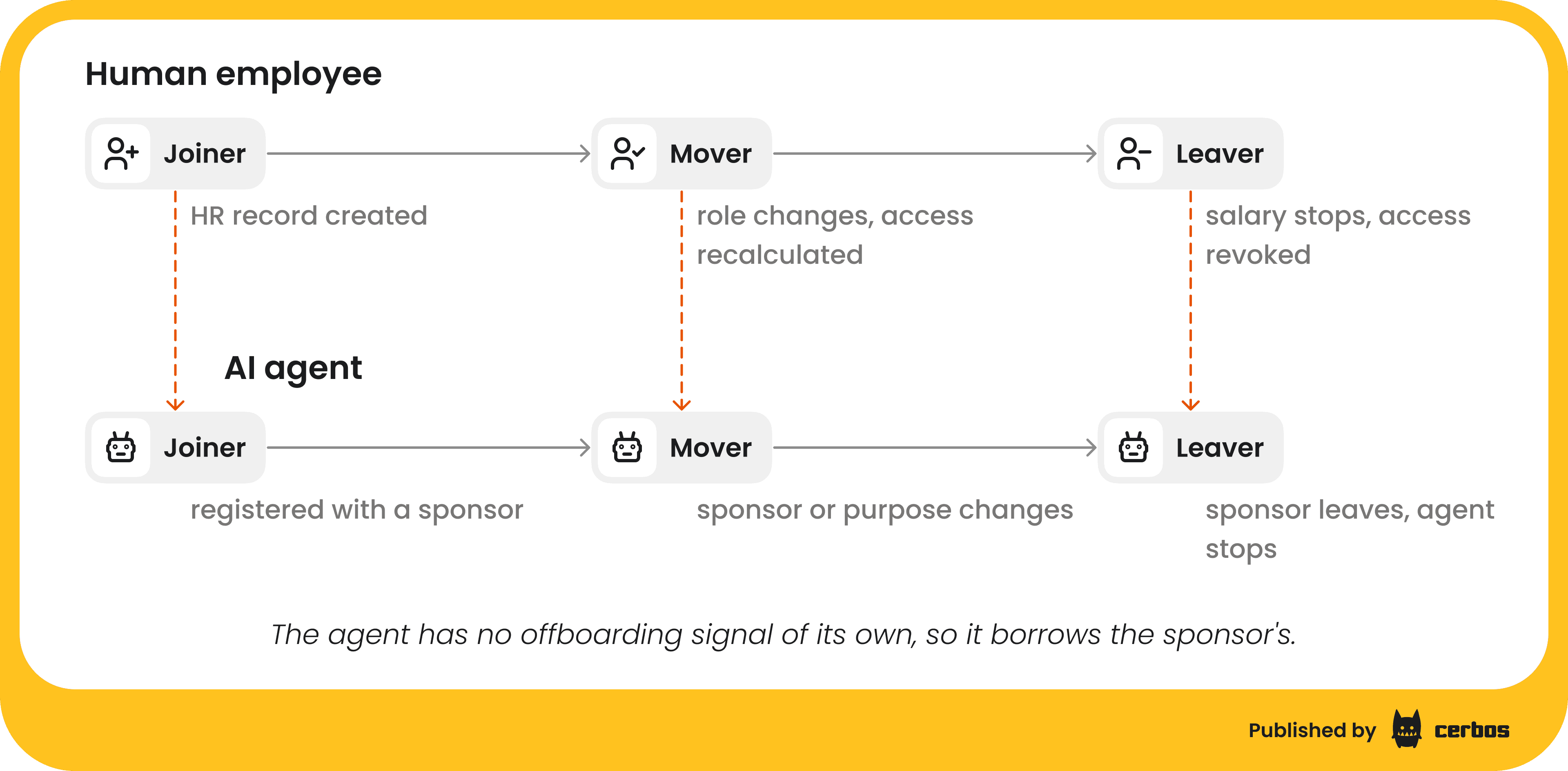
Joiner, mover, and leaver, mapped to an agent
Walking each stage makes the model concrete.
At joiner, an agent is registered before it makes its first call. The registration captures the sponsor, the technical owner, the purpose, the risk tier, and the systems the agent is permitted to reach. The EIC workshop's starting-Monday list put it bluntly. Register every agent as a distinct identity subject with a named human owner, and require registration before any API access. An unregistered agent is not a joiner. It is a shadow agent, and the right default for it is deny.
At mover, two kinds of change matter. The sponsor changes role or team, or the agent's purpose changes. In either case the agent's access is re-evaluated against policy rather than carried forward. Klarl's point on recertification applies here. At agent scale you stop reviewing whether each individual agent still has the right grants and instead recertify the policy that governs the population, whether it still expresses what the business intended. A mover event becomes a policy check, not a ticket.
At leaver, the agent stops. Care's vendor checklist phrases the test as a question you should be able to ask any platform. When an employee leaves, do their delegated agents stop within minutes, automatically. Not at the next quarterly review, not when someone remembers. The EU AI Act's Article 14 frames human oversight in terms of being able to override, reverse, or stop a system, and an agent that keeps running after its sponsor is gone is the plainest failure of that requirement. The kill signal, Care said, should come out automatically when the human leaves the company.
What the policy layer enforces at each transition
Ownership and lifecycle state are inputs. The question that decides whether any of this works is what consumes them at the moment an agent acts. If the sponsor's departure only updates a record, the agent keeps running until something reads the record. If the sponsor's status is an input to the authorization decision on every call, the agent stops on the next request.
That is the enforcement half, and it is the same structure at every stage. At joiner, the policy denies any principal whose registry record does not exist or is not active, which is how registration-before-access becomes a control rather than a policy document. At mover, the policy reads the current sponsor, the current purpose, and the current risk tier rather than the ones the agent was created with, so a change in any of them changes what the agent can do without redeploying it. At leaver, the policy checks that the sponsor is still an active identity in the directory, and if they are not, denies. Nothing has to be torn down in a hurry. The agent's access narrows to zero the moment its anchor is gone, which is the dimmer switch applied to lifecycle. Access fades on a signal instead of waiting for a cleanup job.
The Gartner presentation on IAM for AI agents at Gartner IAM London 2026 said the governance rule in one line. Policies must define who is accountable for the actions made by AI agents. Encoding the sponsor into the policy is how that stops being a slide and becomes a rule that runs.
How Cerbos fits
Your identity governance tooling and directory own the sponsor, the succession, and the lifecycle state, and that is the right place for them. The Cerbos authorization management platform makes those facts decisive at the moment of action.
Every call an agent makes is evaluated by the Cerbos PDP, the policy decision point, against policy that can require the agent's registry record to be active, its sponsor to be a current identity in the directory, and its purpose and risk tier to match the action being attempted. Policies are YAML with CEL conditions, so a leaver rule is a few lines, and a mover is a change to the sponsor attribute rather than a change to the agent.
Cerbos Synapse supplies the lifecycle context. It fetches the agent's registry entry, its sponsor's directory status, and the relationship between them from your IdP and your systems at decision time, so the policy sees the sponsor's real status rather than a copy the agent was handed at startup. Every decision, including the deny that fires the moment a sponsor is deactivated, is written to the audit log with the principal, the sponsor, the policy version, and the timestamp, which is the evidence an auditor asks for when they want to know how long an agent ran after its owner left. The same policy model covers every non-human identity in the estate, so agents are governed by the layer you already use rather than a separate one. The AuthZEN standard means the decision is portable across whatever your governance tooling emits.
Your JML process works because a human's departure sends a signal that everything downstream can hear. Agents do not send that signal. Tie each one to a sponsor who does, make the sponsor's status an input to every decision the agent's actions depend on, and the process you already trust reaches the workforce that was never in it.
Try Cerbos to see an agent's access stop the moment its sponsor leaves, or book a call with our team to walk through how your joiner-mover-leaver process can cover agents.
The full AIAM series:
FAQ
Tagged in