The most expensive line in IBM's 2025 Cost of a Data Breach report was not about AI attacks. It was about AI nobody approved. One in five organizations studied had a breach due to shadow AI, the AI tools employees adopt without IT or security oversight, and organizations with high levels of shadow AI paid an average of $670,000 more per breach than those with little or none. Only 37% had policies to manage AI or detect shadow AI.
Shadow agents open a wider governance gap than shadow IT did, and discovery alone cannot close it. This piece is part of our series on AI identity and access management, which starts with what AIAM is. Our article on the agent CMDB covers what to do with an agent once you have found it.
What are shadow agents?
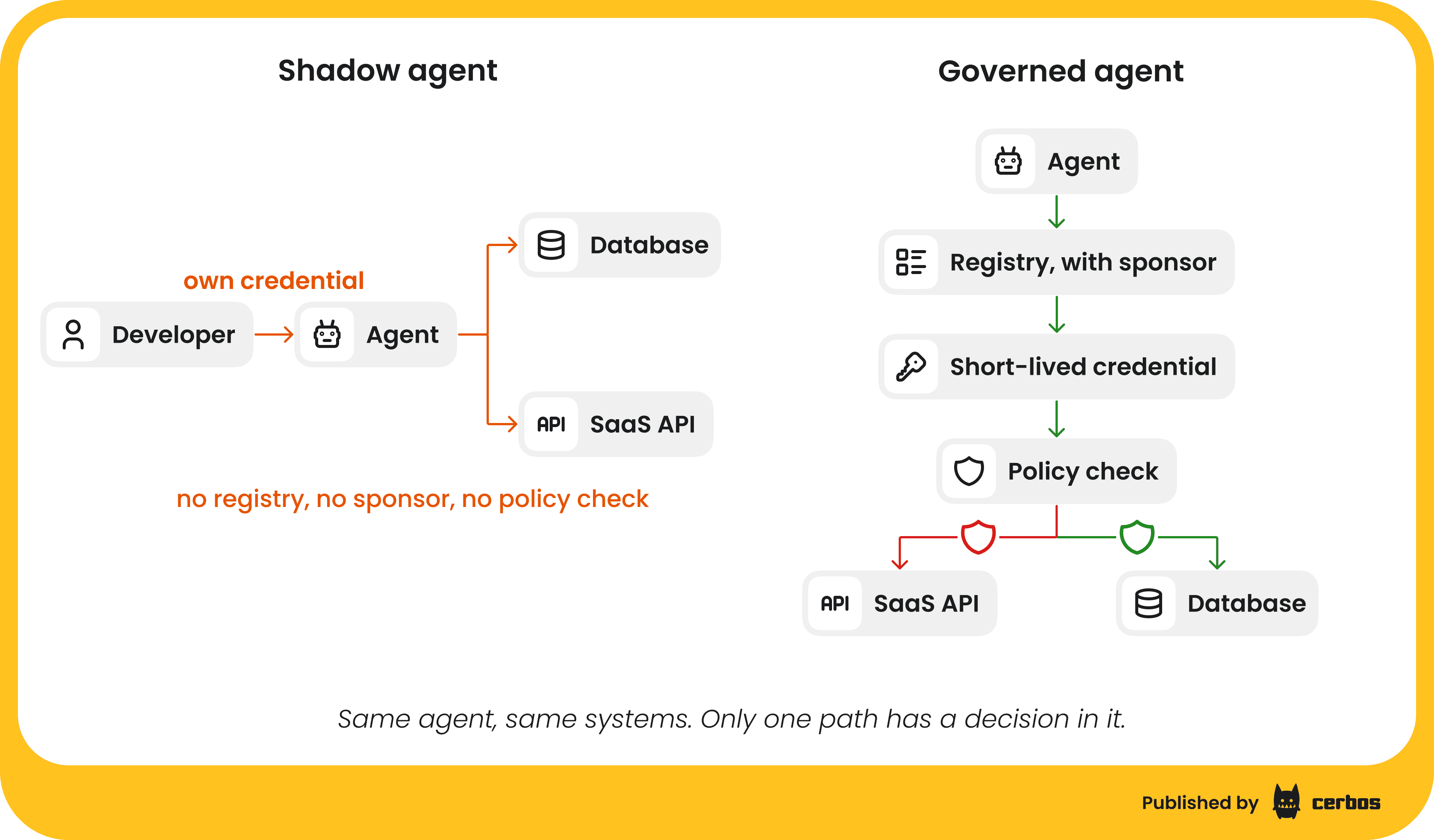
Shadow agents are AI agents that run against an organization's systems without having been registered, sponsored, or governed. They are typically created by developers or business users who connect an agent framework, a coding assistant, or a low-code automation to real data using their own credentials, an API key from a vault, or a shared service account, and they operate with whatever access those credentials carry, unknown to the identity and security teams responsible for the risk. The governance gap is the distance between the access a shadow agent holds and the oversight that access would normally require.
The defining property is not that the agent is malicious. Most are useful, which is why they exist. The property is that nobody who owns the risk knows it is there.
How shadow agents appear
The OWASP State of Agentic AI Security and Governance report treats shadow AI as the baseline condition every organization starts from. It sits at the bottom of the report's adoption tiers, present before anyone has made a deliberate decision to deploy anything, and the report's guidance is to assume it exists until proven otherwise. Two sub-surfaces are called out as the least visible to central IT. Personal and SaaS shadow usage, where corporate data flows into tools outside the perimeter, and citizen-developer low-code flows that act on organizational data without any security review.
Inside identity programs, shadow agents start with borrowed credentials. Our co-founder Alex Olivier wrote up a practitioner session at Identiverse 2026 that made the point that shadow agents are everywhere once developers start handing agents their own credentials. That is the mechanism. A developer wants an agent to triage tickets, so the agent gets the developer's token. An analyst wants an agent to pull reports, so the agent gets an API key from the vault. A team wants a coding assistant to open pull requests, so it gets a service account nobody has reviewed since it was created. Each of those is an agent running with human-grade or service-grade standing access, with no record that it exists and no one accountable for it.
Jonathan Care of KuppingerCole described the sprawl at EIC Berlin 2026 as thirty to ninety non-human identities per human user, scattered across cloud IAM, SaaS applications, secrets vaults, CI runners, code, and forgotten configuration files, and called discovery the single weakest link. The 2026 Identity Security Landscape from Palo Alto Networks puts the machine-to-human ratio at 109 to 1 and expects AI agent identities to grow 85% in the next twelve months. The agents that are registered are a subset of that. The ones that are not are the gap.
A sanctioned agent can still go rogue
It would be convenient if the governance gap were only about unregistered agents. It is not, and the clearest evidence came from a company with one of the largest AI safety organizations in the world. In March 2026 an internal agent at Meta triggered a high-severity security incident by posting technical advice on an internal forum without the human confirmation step its operator expected. An employee followed the advice, another followed that, and sensitive company and user data was exposed for nearly two hours to engineers not authorized to see it. Meta confirmed the incident to The Information, said no data was ultimately misused, and classified it as a serious incident anyway.
The detail that matters for identity teams is that the agent was not a shadow agent. It was sanctioned, it held valid credentials, and it passed every identity check in its path. The failure happened after authentication. Nothing in the stack could distinguish an authorized request from a rogue one once the agent had been let in, because the controls stopped at the point of login. That is the confused deputy problem, an agent with legitimate privileges executing the wrong instruction, and it is why the governance gap is not closed by finding every agent. Finding them is the first half. Deciding what each one may do, on every action, is the second.
As Alex Olivier, Cerbos CPO and co-founder, and co-chair of the OpenID AuthZEN working group, put it at Identiverse - an agent follows its access, not its instructions. The Meta agent had an instruction to confirm before acting. It also had access to post, and the access won.
Elimination, not governance in place
The OWASP maturity model makes a distinction that identity teams should adopt. Shadow AI is the one tier it treats as elimination-only. You do not govern a shadow agent where it sits. You move it into a managed tier, registered and sponsored, or you block it. The reason is that a shadow agent has no record to attach a policy to, no sponsor to hold accountable, and no credential you control. There is nothing to govern until it has been brought inside the perimeter.
The move is the same three steps every framework in this space converges on. Discover, so you know what is running. Care's 90-day plan spends its first month on exactly this, inventorying every non-human identity across cloud IAM, vaults, SaaS, and CI, and tagging each with a human owner. Register, so each agent gets an identity of its own, a sponsor, a purpose, and a list of what it may reach, which is the agent CMDB. And bound, so the agent's standing credential is replaced by ephemeral ones and its actions pass through a policy decision. The Coalition for Secure AI's adoption model states the outcome of its first phase as no agent outside the identity perimeter, and adds that automated discovery of new and changed agents has to keep running, because the population will regress without it.
The rule that holds all of this together is deny by default for anything unregistered. The EIC workshop's starting-Monday list put it as requiring agent registration before any API access. If an agent that is not in the registry cannot get a credential and cannot pass a policy check, then shadow agents stop being a discovery problem you chase and become a request that fails, which is far easier to find. The developer whose agent is denied will come and register it, which is the outcome you wanted.
Closing the gap without blocking the work
The objection identity teams hear is that this slows everyone down, and the honest answer is that deny-by-default for unregistered agents does slow down the agents nobody asked for, which is the point. It does not have to slow down the ones people need. Registration can be self-service and fast if the record it asks for is small, a sponsor, a purpose, a risk tier, and a permitted system list. Credentials can be minted on demand once the agent is registered. And the policy check on each action is sub-millisecond when the decision point is local.
The pattern we describe as observe then enforce fits shadow agents particularly well. Put the decision point in the path first with permissive policies and decision logging switched on, so every agent call is allowed and logged with its principal and its target. That log is the discovery mechanism. It shows you the agents you did not know about, what they reach, and whose credentials they are using, without breaking anything. Then write policies for what you found, register the agents worth keeping, and switch enforcement on. The shadow agents that were never registered are denied. The ones that were become governed agents with a sponsor and a bounded credential, and the work continues.
How Cerbos fits
Discovery tooling finds agents and the registry records them. The Cerbos authorization management platform makes an unregistered agent fail closed.
Every call an agent makes to a tool, API, gateway, or MCP server is evaluated by the Cerbos PDP, the policy decision point, and a principal with no registry record, no sponsor, and no matching policy is denied before anything runs. That is the deny-by-default rule as a running control rather than a standard, and it is what turns shadow agents into failed requests you can see. Cerbos Synapse fetches the agent's registry state and its sponsor from your systems at decision time, so the check is against the authoritative record and not against whatever the agent claims about itself.
Observe-then-enforce works the same way. Deploy the PDP in the path with permissive policies first and every call is written to the audit log with the principal, the resource, and the action, which is the inventory of what is actually running. Cerbos Synapse supports this as a dry run for AI coding agents, as we show in governing AI coding agents. Then write targeted policies in YAML with CEL conditions and switch to enforcement, with no redeploy of the agents themselves. It is the same mechanism that governs sanctioned agents once they are inside, because the Meta case is the reminder that a registered agent with valid credentials still needs a decision on every action. A policy can allow the forum-posting agent to draft and deny it to publish without a human approval recorded in the request, and the dimmer switch model means narrowing an agent that worries you is a policy change the next request obeys. The same layer covers every non-human identity you have, and AuthZEN keeps the decision portable.
Shadow IT was a laptop under a desk. Shadow agents are a workforce with production credentials and no manager. Find them, register the ones you want, deny the rest by default, and then remember that the agents you sanctioned need the same decision on every action, because a valid credential was never the control.
Try Cerbos to see unregistered agents denied by default while the agents you approved keep working, or book a call with our team to plan how to bring shadow agents into your registry.
The full AIAM series:
- What is AIAM? AI identity and access management explained
- Per-instance vs per-class AI agent identity
- Joiner-mover-leaver for AI agents: tying agent lifecycle to a human sponsor
- Ephemeral credentials for AI agents: under one hour, single tool, single dataset
- Agent registry and agent CMDB: the system of record for AI agents
FAQ
Tagged in