If you are comparing Cerbos with PingAuthorize, you probably already run Ping for identity. PingFederate, PingOne or PingAM signs your people in, and the question in the room is whether authorization should come from the same vendor, as PingAuthorize or its SaaS version, PingOne Authorize, or from a separate layer. It is a reasonable question, and the answer will decide who owns the rules for every application, gateway and AI agent you run for the next several years.
Keeping Ping for identity does not settle where authorization lives. The two products differ in how policy is written, reviewed and tested, how far one set of policies reaches, what evidence each leaves for an auditor, and which open standard they implement.
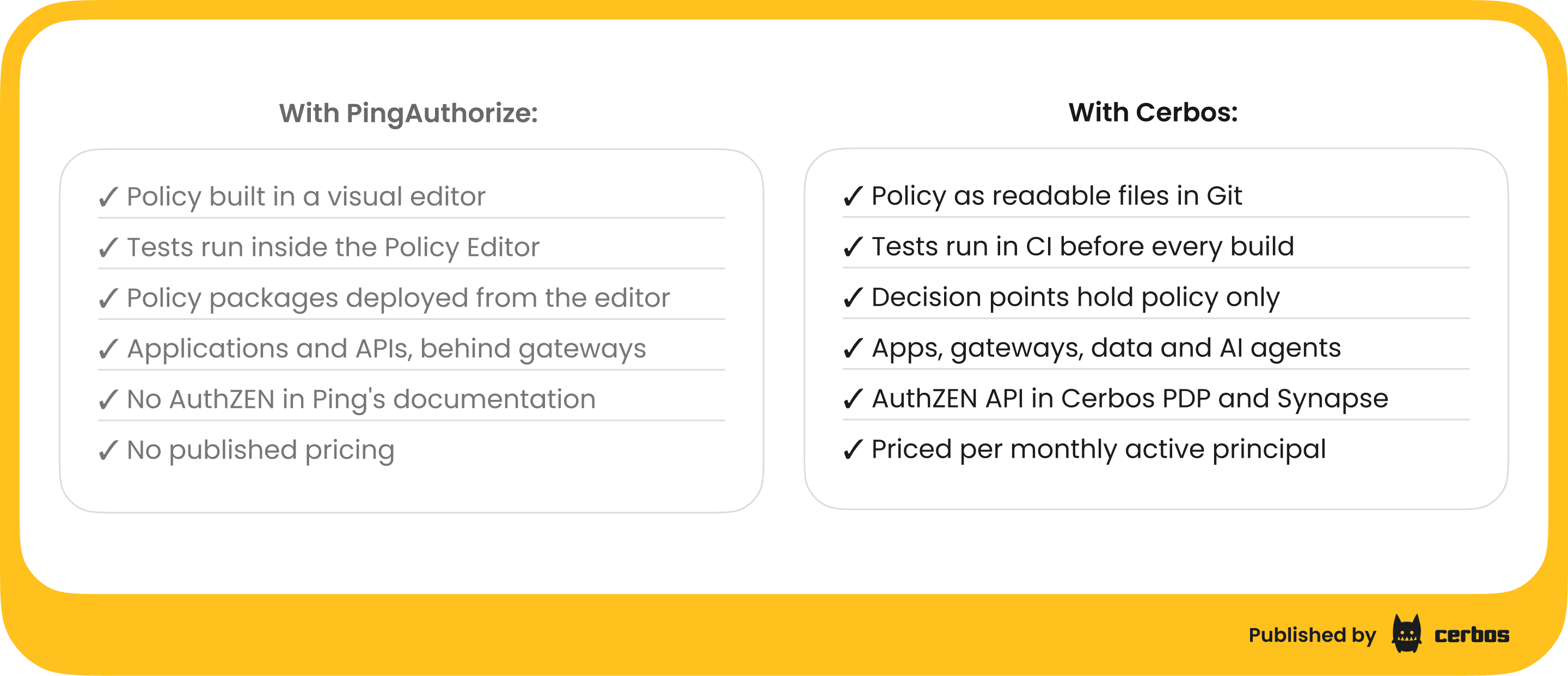
Cerbos vs PingAuthorize at a glance
| Question | Cerbos | PingAuthorize and PingOne Authorize |
|---|---|---|
| What it is | An authorization management platform that works with any identity provider, Ping included. Decision points run next to every workload, Cerbos Hub manages policy, testing and audit, and Cerbos Synapse brings in context and connects gateways, data platforms and AI agents. | Ping's authorization products. PingAuthorize is self-managed, a Policy Editor plus PingAuthorize Server. PingOne Authorize is the SaaS version, with optional gateways that run decisions in your network. |
| How policy is written | Short YAML policies with conditions in CEL, reviewed in pull requests. | A visual Trust Framework and policy tree, built with drag and drop in the Policy Editor or the PingOne console. |
| Version control and testing | Git, with test suites that Cerbos Hub runs before it builds each deployment. | The Policy Editor's own Branch Manager and snapshots, and a Test Suite inside the editor. Git is not mentioned in Ping's documentation (October 2026). |
| Coverage | One set of policies across applications, API gateways and service meshes (Kong, Apigee, Envoy and Istio), data platforms and event streams, Kubernetes, MCP servers and AI agents. | Applications and APIs, with PingAuthorize Server as a reverse proxy or a sideband behind Kong, Apigee or MuleSoft. |
| Standards | Cerbos PDP and Cerbos Synapse both implement the AuthZEN Authorization API. Alex Olivier, Cerbos cofounder and CPO, co-chairs the OpenID AuthZEN Working Group. | Ping’s documentation does not mention AuthZEN. |
| Pricing | Public, by monthly active principals. $0 proof of concept, Development from $25 a month, Production from $933 a month, Enterprise custom. | Priced on active users. No price for PingAuthorize or PingOne Authorize is published. |
| Company | Founded 2021, London. | Ping Identity, Denver. Owned by Thoma Bravo, which combined ForgeRock into Ping in 2023. |
Keeping Ping for identity while choosing authorization separately
Most teams comparing the two are not replacing Ping. They have years of federation, directories and sign-in flows built on it, and those keep working. The decision is whether the identity vendor should also own every authorization rule.
PingAuthorize reuses the Ping directory and enriches the token you already issue. That fit is real, and it also ties authorization to Ping’s upgrade cycle and roadmap. Since Thoma Bravo combined ForgeRock into Ping in 2023, Ping also carries more than one authorization model. PingAuthorize and PingOne Authorize use the Trust Framework, while PingAM and PingOne Advanced Identity Cloud, from ForgeRock, keep their own policy sets and agents.
Cerbos works downstream of whatever signs people in. The application passes the claims from a PingFederate or PingOne token, such as groups, populations and custom attributes, to Cerbos as attributes of the person making the request, as described on our Ping Identity integration page. Where a decision needs something the token does not carry, Cerbos Synapse fetches it at decision time, from PingDirectory over LDAP, from PingOne through its API, or from the system that owns it. Ping keeps doing identity, and Cerbos evaluates your policies to answer what each person, service or agent may do. If you ever add a second identity provider after an acquisition, the authorization layer does not change.
Where authorization policy lives in Cerbos and PingAuthorize, and who can review it
Security approves the rules, identity governs them, and an auditor will eventually ask to see the rule that was in force on a particular day.
PingAuthorize policy is built in a visual editor. The Trust Framework defines domains, services, actions and attributes, and policies are arranged in a tree of policy sets, policies and rules with combining algorithms such as first applicable, the default. Ping describes the editor as built for nontechnical stakeholders. The drag and drop helps someone build a rule, and the rule then lives in the Policy Editor's own store, with its own Branch Manager, snapshots exported from the user interface and a Test Suite that runs inside the editor. Git is not mentioned in Ping's documentation, and neither is a way to run those tests in a CI pipeline.
In Cerbos, the policy is the file. A rule such as "an advisor can view the accounts of their own clients" is a few lines of YAML with a condition in CEL, the open expression language Kubernetes and Envoy also use. Policies live in Git or in Cerbos Hub policy stores, so changes go through the pull request review your organization already uses, with an author, a reviewer and a timestamp on every change. Test suites sit next to the policies and run in any CI system, and Cerbos Hub only builds a deployment when they pass. People who do not write YAML every day use the Cerbos Hub playground, where a permissions matrix shows who can do what before a change is proposed.
When the policy is a file reviewed like code, the approval trail sits in the same system as every other production change, and nothing about the rule depends on one vendor's editor to make sense.
What Cerbos and PingAuthorize decision points depend on
A central authorization service has to keep answering through upgrades and outages, so what each decision point depends on matters as much as the answers it gives.
PingAuthorize Server evaluates a deployment package published from the Policy Editor. PingOne Authorize runs decisions in Ping’s cloud, or in Authorize gateways in your network that take policy from PingOne, and according to Ping’s documentation (October 2026) each gateway version is supported for one year after the next version ships.
Cerbos decision points are stateless and hold policy only. They run wherever the workload does, as a shared service, a sidecar, a DaemonSet, a serverless function or in the browser through WebAssembly, and they scale by adding instances. Cerbos Hub sends policy to them encrypted with each deployment's own credentials. If Hub is unreachable, running decision points keep serving the last policy they received, and new ones start from the last built copy. For regulated teams that need the control plane in their own network, Cerbos Hub runs on-premise, including air-gapped.
Decision time data in Cerbos and PingAuthorize
Fine-grained decisions depend on attributes, a person's department and clients, an account's owner and region. Both platforms read the claims in the token Ping issues and fetch what the token does not carry from the systems that hold it, when the decision is made. PingAuthorize does it with resolvers in the Trust Framework, calling HTTP, LDAP, database and SCIM services in order, with caching, and it can also enrich the token Ping already issues.
Cerbos decision points are stateless. They hold policy and nothing else. The application sends what it has, including JWT claims from Ping, and Cerbos Synapse fetches the rest from PingDirectory, PingOne or the database or API that owns it, with caching set to how often each one changes. We walk through that pattern in looking up identity attributes at decision time. Synapse is also what Envoy, Istio, Kafka and Trino call for their decisions, so the layer that brings in attributes for an application is the same one that serves your gateways and data platforms, and one set of policies reads the same attributes wherever it is enforced.
Authorization across applications, gateways, data platforms and AI agents
PingAuthorize Server can run in the API path, as a reverse proxy or as a sideband behind an API gateway such as Kong, Apigee or MuleSoft. That covers APIs. Ping launched "Identity for AI" in March 2026, with an agent gateway and agent detection, and describes fuller MCP authorization as future work.
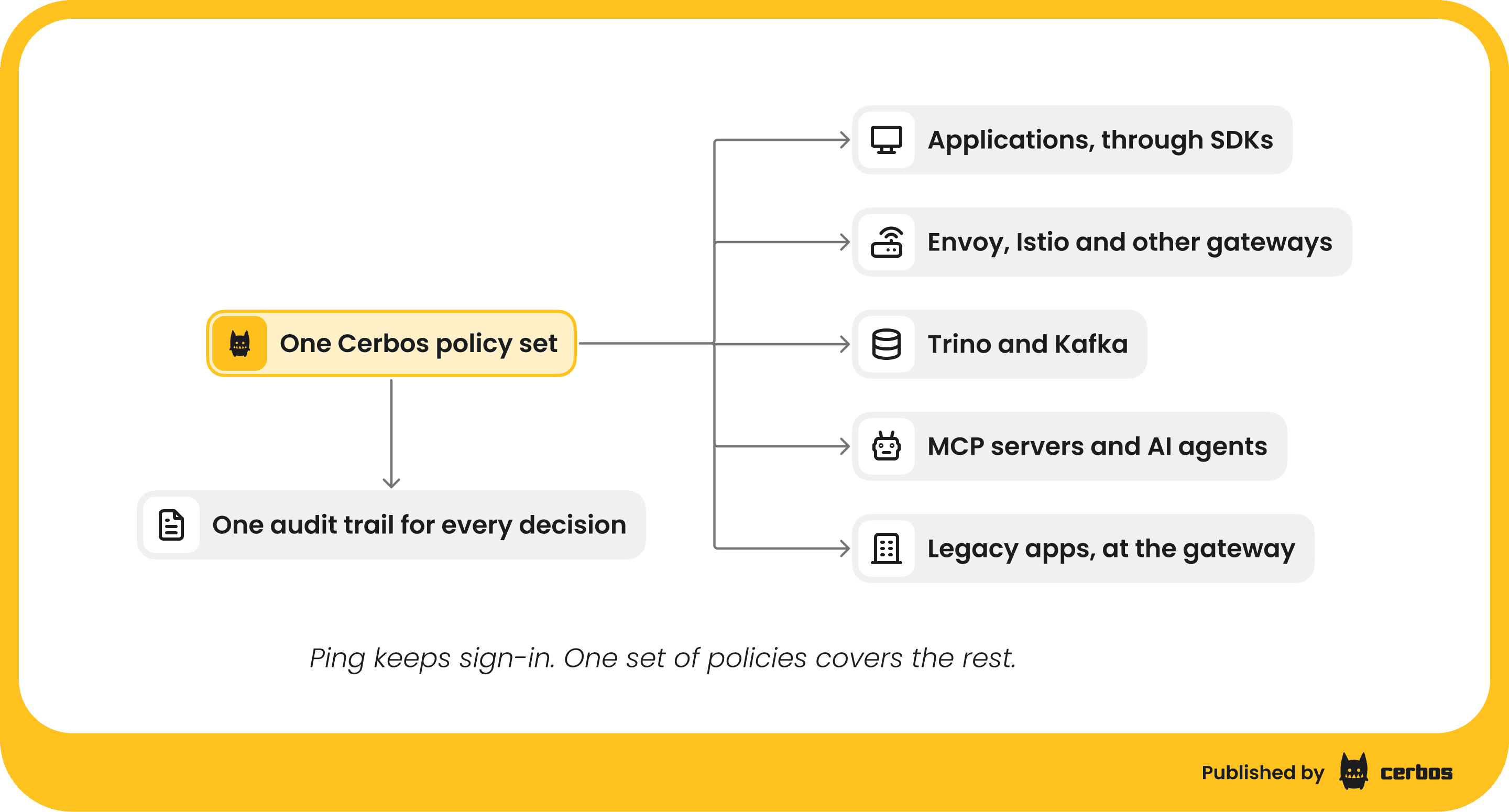
Cerbos covers each of these layers from one set of policies and one audit log.
- Applications call Cerbos through an SDK, one call in place of permission checks scattered through the codebase.
- Kong and Apigee call Cerbos through its API or AuthZEN, and Cerbos Synapse is the external authorization service for Envoy and Istio.
- Data platforms get Cerbos answering Trino's authorization calls, so a query returns only the rows and columns a person may see, and Kafka's, so only approved services read or write a topic.
- Applications you cannot change are governed at the gateway in front of them, with no code changes.
- AI agents have every tool call checked against policy before it runs, down to the arguments, wherever you enforce it, in the agent harness through hooks, as with Claude Code, at an MCP gateway or proxy, or in the MCP server itself. When an AI gateway such as LiteLLM or agentgateway sits between the application and its models, the same policies cover tool calls and which models an agent may use, as we describe in governing AI agents at the gateway. The agent's token and the person's token travel in the same request, so a policy can require both.
Agents follow access, not instructions, so a prompt is never the control. Put Cerbos in front of an agent's tool calls before writing any policy, with audit logging on, and every call passes through and is logged with the person behind it, the tool and its arguments. Write the policy from that record, then narrow it, ead-only on payment systems or only the tools each role needs, and each change applies on the next call.
Filtering and masking API responses with PingAuthorize statements and Cerbos outputs
Some decisions are not only allow or deny. A customer may see their account, but not the full account number.
PingAuthorize handles this with statements, such as Filter Response, Exclude Attributes and Regex Replace Attributes. When PingAuthorize Server sits in the API path, it applies them to the request or response itself. When an application calls the decision API instead, Ping's documentation says the application has to implement the statement.
Cerbos rules return outputs, values computed in CEL and returned with the allow or deny. A rule can return "mask the account number" for an advisor and nothing for a fraud analyst, and the application applies it. For lists and searches, query plans turn the policy into a filter your data layer applies, so a search only returns the records a person may see. On Trino, row filters and column masks are applied by the query engine itself. Cerbos returns the output with the decision, and the system that asked, your application or the service behind your gateway, applies it to the JSON response.
Audit logs and compliance evidence in Cerbos and PingAuthorize
What a security team needs is a fast answer to "show me the policy that was in effect at the time", for any decision, months later.
PingAuthorize records decisions through its Policy Decision Logger and shows them in a Decision Visualizer. PingOne Authorize keeps the most recent decisions per endpoint in the console and sends audit events out through webhooks.
A Cerbos decision log records the request inputs and the outcome of every decision, linked to the policy version that made it. Cerbos Hub collects those logs from every decision point into one searchable trail, filtered by person, resource, action or outcome, and you can export them, encrypted, into your own archive or SIEM. Hub keeps logs for three months on Development, a year on Production and as long as you need on Enterprise. With the Git history of every policy change alongside, the access decision evidence an auditor asks for comes from a search, not a reconstruction.
Cerbos holds a SOC 2 Type II attestation. The decision and policy change records are what give your own SOC 2, ISO 27001, HIPAA, PCI DSS or DORA audits their access control evidence.
Standards, portability and lock-in with Cerbos and PingAuthorize
Authorization tied to the identity vendor is portable only as far as that vendor's products go. PingAuthorize policy lives in the Trust Framework and Policy Editor, and moving it means rebuilding it.
Cerbos policies are readable YAML with conditions in CEL. Cerbos PDP, the decision engine inside the platform, is open source under Apache 2.0, so the component in your request path can be inspected line by line, and the policies carry their own test suites.
On the request side, Cerbos PDP and Cerbos Synapse both implement AuthZEN, the OpenID Foundation's Authorization API for how enforcement points ask for decisions. Ping's documentation does not mention AuthZEN. Alex Olivier, our cofounder and CPO, co-chairs the AuthZEN Working Group, so read our view on it with that in mind. A standard request format means your enforcement points do not have to change if your decision service does.
Cerbos and PingAuthorize pricing
Cerbos publishes its pricing, based on monthly active principals, the people and services that get an authorization decision in a month.
- Proof of concept. $0, with a week of unified audit logs.
- Development. From $25 a month, with three months of audit logs.
- Production. From $933 a month, with unlimited workspaces, decision points and tenants, and a year of audit logs.
- Enterprise. Custom, adding SSO, self-hosted Cerbos Hub, custom audit log retention and phone support.
Ping prices on active users, and publishes no price for PingAuthorize or PingOne Authorize. When you compare, ask which Ping edition includes the decision APIs and gateway features you use.
Cerbos at enterprise scale
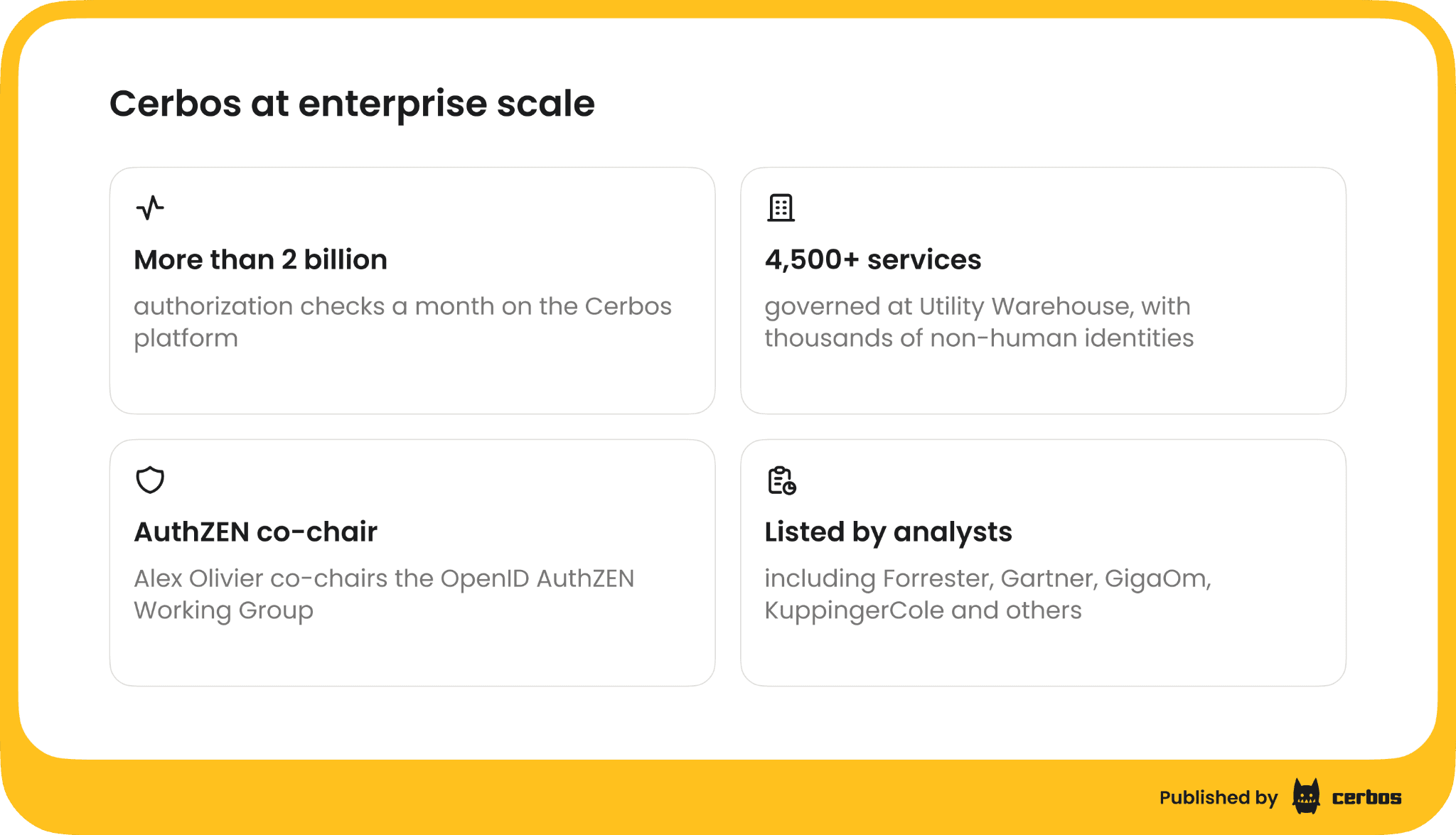
Utility Warehouse, a FTSE 250 company, runs Cerbos across more than 4,500 services and thousands of non-human identities, with millions of access decisions a day, and the platform as a whole handles more than 2 billion authorization checks a month. Alex Olivier, our cofounder and CPO, co-chairs the OpenID AuthZEN Working Group, which wrote the standard API that applications and gateways use to ask for an authorization decision.
Analysts follow the category as well. Cerbos is recognized in the AuthZEN category of the Gartner® Hype Cycle™ for Digital Identity, 2026, and is included in multiple KuppingerCole Leadership Compass reports, including ones on policy based access management, API security and management and generative AI defense, and more.
When PingAuthorize may still fit
If your policy owners will only work in a drag and drop editor, or you depend on PingAuthorize Server rewriting API responses in the request path with no change to the application, keep that gateway where it runs and move the decisions for everything else to Cerbos service by service, which the migration guide walks through.
Choosing between Cerbos and PingAuthorize
For an organization that wants authorization as a shared service across applications, gateways, data platforms and AI agents, Cerbos is the stronger choice, and Ping keeps doing identity. The policy is a file your engineers, security reviewers and auditors can read, tested before it ships, and the same policies cover your gateways, data platforms and AI agents with one audit log.
As Rob Crowe, Principal Engineer at Utility Warehouse, put it, "We have a proper tool to depend on and I trust Cerbos' workflows. If the green tick says that it is built, then we know it should work."
Try Cerbos with your own policies. Your engineers replace the permission checks in every service with one call, your identity team keeps Ping for sign-in while one set of policies covers applications, gateways, data platforms and AI agents, and your security team can pull the policy behind any decision, an AI agent's tool call included, when an auditor asks.
To plan the move from PingAuthorize, book a call with our team and leave with a migration plan your security and audit teams can review.
Go deeper:
- PingAuthorize alternatives
- Migrating from PingAuthorize to Cerbos
- How Cerbos works
- A CISO's benchmark for authorization maturity (eBook), for scoring where your authorization program stands today
FAQ
Tagged in