If you are looking at EmpowerID alternatives, you probably do not want to replace everything EmpowerID does. Most teams in this position run EmpowerID for identity governance, provisioning, access certification and often SAP, and the question is narrower.
Since Omada acquired EmpowerID in September 2026, they are checking whether the fine-grained authorization inside their applications, APIs and AI agents should stay tied to an identity governance roadmap.
Others are new to EmpowerID and want to know what else makes the same runtime decision.
The right alternative depends on which of those you are, because most tools on alternatives lists do a different job.
What EmpowerID does today
EmpowerID, founded in 2005 and based in Dublin, Ohio, sells an identity governance platform, now branded EmpowerID by Omada. It covers joiners, movers and leavers, access requests and certification, separation of duties, privileged access, and connectors that reach SAP, Active Directory, Workday and ServiceNow, with an Identity Warehouse on Microsoft SQL Server that inventories identities and entitlements from every connected system.
Authorization is one pillar of that platform. EmpowerID's documentation describes a hybrid model, where access is precalculated from roles for governance and ABAC conditions are checked at access time, plus a newer decision point it calls Governed Authorization. Its agent products, Agent Governance and Execution, the MCP Gateway and the LLM Gateway, are labeled Early Access on its site (October 2026). It is offered as SaaS, as a dedicated single tenant deployment, or on-premise, and it does not publish pricing.
Why teams look for an EmpowerID alternative
A change of owner, with the roadmap still being written. Omada, a Danish identity governance vendor, announced the acquisition on 24 September 2026 and made EmpowerID's founder its Chief Innovation Officer. KuppingerCole expects the integration to take 12 to 18 months, points to the risk of two overlapping identity governance product lines, and advises EmpowerID customers to confirm support commitments and how their customizations carry forward. The same analysis notes that, per customer reports, EmpowerID's "flexibility has not always meant robust standard functionality". For a team whose authorization rules live in EmpowerID, that is a reason to decide on purpose where those rules should live for the next five years.
Authorization that lives inside identity governance. When roles, access levels and PBAC policies sit in the same platform as provisioning and certification, the runtime rules move at the pace of the governance suite. Engineering teams want to change a rule, test it and ship it like any other production change. EmpowerID says its app authorization contracts are projected into policy, grants and tests, and the developer documentation for its newer decision point (October 2026) lists a lint script, a pre-commit hook and a manual testing checklist. We found no documented test runner that blocks a release.
Decisions that start from precalculated grants. Precalculated access suits certification reviews, with conditions checked at access time on top. Teams that want every decision evaluated from the record’s state, the amount, the region and the agent acting for a person, with no precalculated layer to keep in step, look for a different model.
Coverage beyond the application. Authorization increasingly has to cover API gateways, service meshes, Kafka, Kubernetes, data platforms and AI agents with the same rules and one audit trail. EmpowerID lists gateways among its enforcement points without naming an API gateway, service mesh, Kafka, Kubernetes or data platform integration (October 2026).
AI agents going into production. Teams rolling out agents need every tool call checked against policy now, with the person behind the agent in the same decision.
Cost you cannot model up front. EmpowerID licenses by governed identity class and product scope and publishes no prices, so the cost of its authorization on its own is unknown until a sales cycle is under way.
Who needs an EmpowerID alternative, and how urgently
Not everyone needs to move now. If EmpowerID only governs identities and roles, and your applications make their own decisions from its tokens, there is no authorization to move, and nothing here needs to change.
It is more urgent if any of these is true.
- Your fine-grained authorization rules live in EmpowerID, and you want them off the Omada integration roadmap.
- Policy changes have to be reviewed in Git and tested in CI before they ship.
- Authorization has to reach API gateways, data platforms, Kafka or Kubernetes as well as applications.
- You are rolling out AI agents and need tool calls authorized this quarter.
- A renewal is coming, and you want a second option running against your own traffic first.
What to look for in an EmpowerID alternative
Ask any replacement for EmpowerID's authorization these questions.
- Does it decide at runtime? Per request, against the current state of the person, the record and the request, or from access calculated in advance?
- Does it work with the identity governance you keep? Can it read roles and attributes from EmpowerID or Omada tokens, and fetch the rest from the systems that own them, without copying identities into a second store?
- Who can read the policy, and how is a change tested? Readable policy your security reviewers approve, with tests that block a release when they fail?
- How far does one set of policies reach? Applications only, or also API gateways, service meshes, data platforms, Kafka, Kubernetes and AI agents?
- Can it govern AI agents today? Tool calls and their arguments checked before they run, the person behind the agent in the same decision, whether you enforce in the agent's hooks, at an MCP gateway or at an AI gateway?
- Is every decision on record? With the inputs, the outcome and the policy version that made it, searchable months later?
- Where can it run, and what happens if the control plane is unreachable? Hosted, on-premise or air-gapped, and do decision points keep working?
- Does it follow open standards? Does the decision API follow AuthZEN, so enforcement points do not change if the decision service does?
- What does it cost? Is the price published, and is authorization priced on its own?
For a full breakdown of what to look for when selecting an authorization solution - refer to our detailed framework.
The main types of EmpowerID alternative
Lists of EmpowerID alternatives mostly name access management and single sign-on tools, because review sites file EmpowerID under identity and access management. Only some of those make the decision EmpowerID's authorization makes.
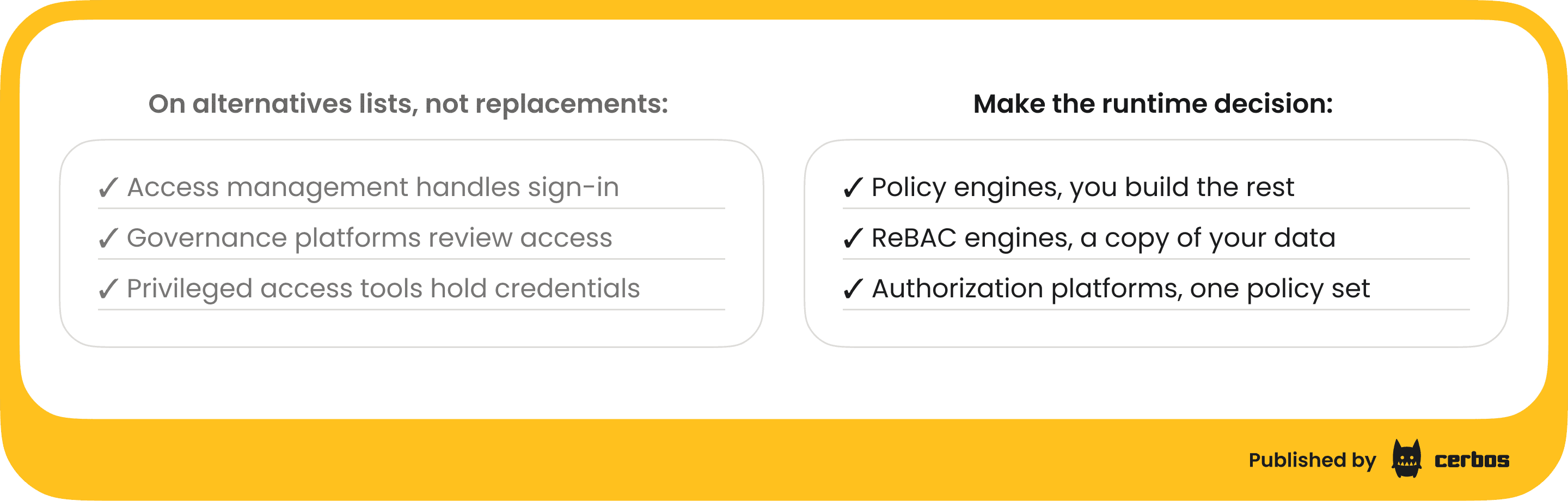
Access management and single sign-on. Tools that sign people in, manage directories and multi-factor authentication, and put roles in a token. They answer who someone is. They do not decide whether this person may approve this payment on this record at this moment.
Other identity governance platforms. Platforms that provision accounts, run access requests and certification campaigns, and manage separation of duties. If identity governance is what you are replacing, this is your category, and it is a different evaluation from this one. Most of them leave fine-grained runtime decisions to the applications.
Privileged access tools. Vaults and session managers for administrators and service accounts. They control who holds powerful credentials, not what each user can do inside an application.
General policy engines and languages. Open source engines that evaluate policy written in their own language. They make fine-grained decisions, and on their own they leave policy distribution, testing, audit collection and attribute loading to your team.
ReBAC engines. Services modeled on Google's Zanzibar paper store relationships, such as who owns which folder and which group contains which user, and answer by walking that graph. They need every relationship written into them, which is a second copy of identity data to keep in step with your governance platform.
Building your own. Authorization written into each application. It works until the number of services, regulators and auditors grows, and every change becomes a release. Our post on build vs buy covers where that line falls.
Authorization management platforms. A decision engine plus the management around it, policy authoring and testing, distribution to every decision point, audit collection, and context fetched from your other systems at decision time. This is the type that replaces the runtime authorization EmpowerID provides while your identity governance stays where it is, and it is where Cerbos sits.
Cerbos as an EmpowerID alternative
Cerbos is an authorization management platform. Decision points run next to every workload, Cerbos Hub manages policy, testing and audit, hosted or on-premise, and Cerbos Synapse brings in context and connects gateways, data platforms and AI agents.
Keep EmpowerID for identity governance
Cerbos does not replace provisioning, certification or SAP connectors, and it does not need to. Your application reads the roles, groups and organizational scope from the tokens EmpowerID issues and passes them to Cerbos, as our EmpowerID integration describes, and Cerbos Synapse fetches whatever the token does not carry, from EmpowerID itself or from the system that owns it. A role change in EmpowerID applies on the next decision, because Cerbos keeps no copy of your identities. Whatever Omada decides for the EmpowerID product line, your authorization rules stay where they are.
Decisions made per request, against current data
Cerbos decision points are stateless and evaluate each request against the person, the resource and the request as they are at that moment, as we show in looking up identity attributes at decision time. For lists and searches, query plans return the rules as a filter your database applies.
Policy your reviewers can read, tested before it ships
A Cerbos policy is a short YAML file with conditions in CEL, kept in Git or in Cerbos Hub policy stores. A test suite sits next to each policy, and Cerbos Hub only builds a deployment when the tests pass. Where EmpowerID scopes rules by location and inheritance level, scoped policies let a business unit narrow what the organization allows.
One policy set for applications, gateways, data and agents
The same policies cover applications through SDKs in eight languages, API gateways and service meshes (Kong, Apigee, Envoy and Istio), Trino row and column filtering, Kafka topics, Kubernetes admission, and applications you cannot change through the gateway in front of them.
AI agents governed today
Every agent tool call is checked against policy before it runs, down to its arguments, with the person behind the agent in the same decision. Enforce it in the agent harness through hooks, as with Claude Code, at an MCP gateway or in the MCP server, or at an AI gateway such as LiteLLM or agentgateway. Cerbos evaluates the request and does not hold credentials, which stay in your secrets manager or gateway. Start before writing any policy, with audit logging on, so every call is recorded, then narrow access, and each change applies on the next call, the approach we describe as a dimmer switch.
Every decision on record
Every decision is logged with its inputs and outcome, linked to the policy version that made it, and Cerbos Hub collects those logs from every decision point into one searchable trail you can export to your SIEM. Cerbos holds a SOC 2 Type II attestation, and the records give your own audits their evidence.
Decision points that keep running
Decision points run as a shared service, sidecar, DaemonSet, serverless function or in the browser. If Cerbos Hub is unreachable, they keep serving the last policy they received. Hub runs hosted, or on-premise and air-gapped for enterprise customers.
Open standards and published pricing
Cerbos PDP and Cerbos Synapse both implement the AuthZEN Authorization API, and EmpowerID appears in the AuthZEN interoperability results too, so enforcement points built to the standard do not have to change when the decision service does. Alex Olivier, our cofounder and CPO, co-chairs the AuthZEN Working Group. Cerbos pricing is published, from a $0 proof of concept to Production from $933 a month, based on monthly active principals.
Proven at enterprise scale
The Cerbos platform runs more than 2 billion authorization checks a month, and Utility Warehouse uses it across 4,500 services and millions of non-human identities.
When Cerbos is not the right EmpowerID alternative
If what you need to replace is identity governance itself, provisioning, access certification, separation of duties, privileged access or SAP identity management, Cerbos is not that product. Choose your governance platform for those, and use Cerbos for the runtime decisions it feeds.
Moving authorization off EmpowerID without a big bang cutover
You do not have to move everything at once, and identity governance does not move at all.
- List the decisions EmpowerID makes today. For each application, which roles, access levels and PBAC policies it relies on, and which attributes each condition uses.
- Write the rules as Cerbos policies, with tests. Write each rule from its intent, and turn the decisions you know must hold into a test suite.
- Decide where each attribute comes from. Most come from the EmpowerID token or the application. The rest Cerbos Synapse fetches from EmpowerID itself or from the system that owns it.
- Run Cerbos in shadow mode. Send each request to both, keep enforcing EmpowerID's answer, and log both until they match.
- Cut over one application at a time, then retire that application's authorization rules in EmpowerID.
Our migration guide maps EmpowerID's roles, access levels, PBAC policies and inheritance levels to Cerbos with a worked policy and tests, and Cerbos vs EmpowerID compares the two section by section.
Try Cerbos with your own policies. Your identity team keeps EmpowerID for governance while the authorization rules stop depending on the Omada roadmap. Your engineers ship a rule change like any other tested change. Your security team gets one record of every decision, linked to the policy that made it, for the next audit. To plan the move from EmpowerID, book a call with our team and leave with a migration plan your security and audit teams can review.
Go deeper:
- Cerbos vs EmpowerID
- Migrating authorization from EmpowerID to Cerbos
- How to adopt externalized authorization (eBook), for a step by step plan to move authorization out of applications and suites
- Securing AI agents and non-human identities in enterprises (eBook)
FAQ
Tagged in