You know who your users are. That is the part enterprise IAM has mostly solved. The harder question, and the one that shows up in audits and incident reviews, is what those identities can actually do once they are inside your applications. That decision usually lives hardcoded in application code, spread across dozens of services, outside the identity team's governance reach.
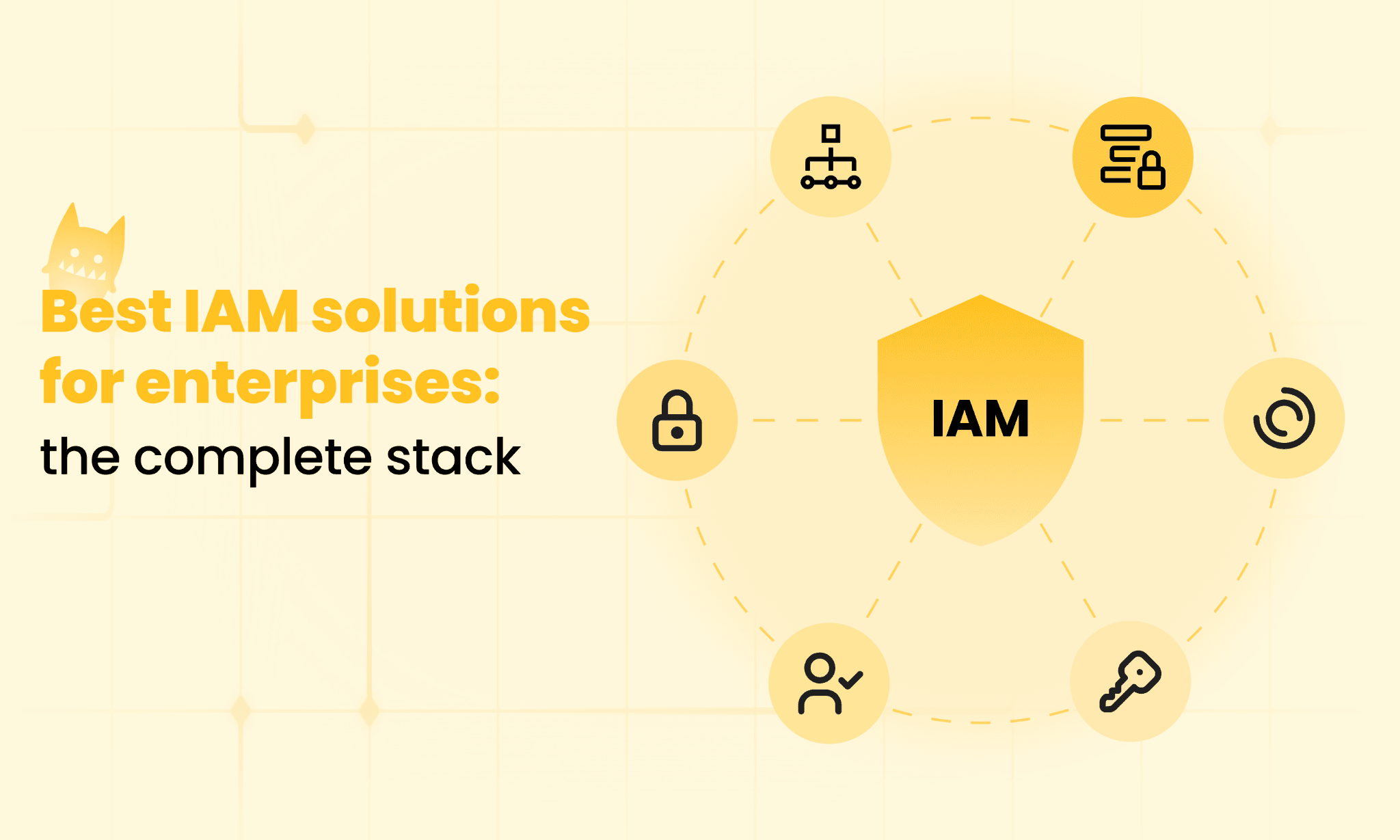
Enterprise identity is not one product. It is a stack of them, an identity provider for single sign-on, an identity governance tool for certification and lifecycle, a privileged access platform for the accounts that matter most, secrets management for machines, and the authorization layer that decides each action at runtime. No single vendor covers all of it well, and the market blurs the categories together.
This guide breaks enterprise IAM into the domains you actually have to buy for, names the notable solutions in each and what they do, and shows which one most programs under-invest in. It is the layer that turns "who is this identity" into "what is it allowed to do right now," and it is usually the piece still missing from the stack.
What enterprise IAM actually has to cover
Three things separate an enterprise identity program from a smaller one, and they are why the stack gets large.
Scale and heterogeneity. A large enterprise runs thousands of applications across cloud and on-prem, acquired business units on different identity systems, and a workforce that changes every day. The tooling has to federate all of it, not just the greenfield SaaS.
Compliance and proof. SOC 2, ISO 27001, HIPAA, PCI DSS, and sector regulations mean an enterprise has to show, on demand, who has access to what and why, and prove that access is reviewed and revoked. Identity is not just an operational function, it is an audit function.
Every identity, not just employees. Service accounts, workloads, and now AI agents authenticate and act on their own, usually with broad tokens and no clear owner. Governing non-human identities is now part of the same remit, and it is where visibility tends to be thinnest.
Across all of that, most investment goes into establishing identity and provisioning access. The decision of what an authenticated identity may actually do, per action, inside each application, is the part that stays in application code, which is exactly the part an identity team has the least visibility into. Keep that in mind as you read the categories below.
The domains of enterprise IAM
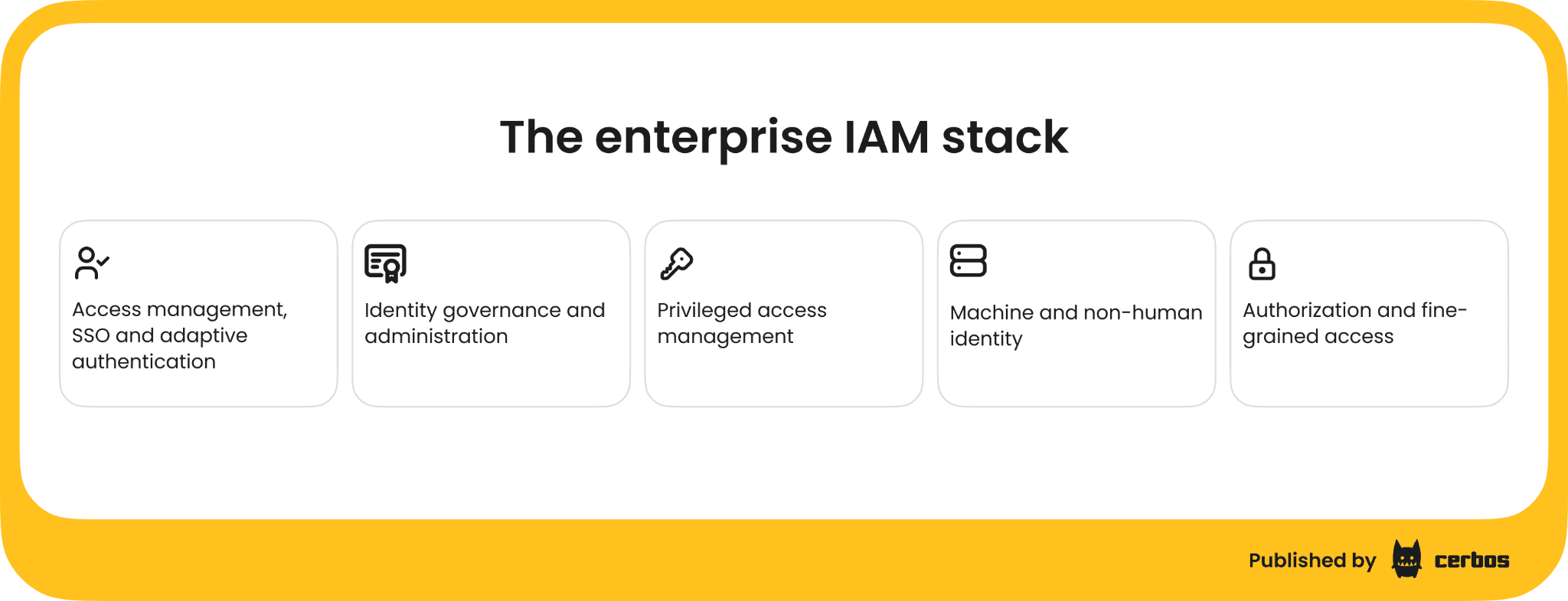
1. Access management, SSO and adaptive authentication
This is the front door, single sign-on, multi-factor authentication, and conditional access that weighs signals like device and location before granting a session. For most enterprises this is the center of the identity program and the system of record for workforce identity.
Okta anchors many enterprise programs through its Workforce Identity Cloud, with phishing-resistant adaptive MFA, a universal directory that consolidates identities, and one of the largest integration networks, which makes it the common choice for vendor-neutral, multi-cloud estates.
Microsoft Entra ID is the default where the organization already runs on Microsoft, with conditional access that weighs user, device health, location, and risk, and tight coupling to the rest of the Microsoft security stack.
Ping Identity is common in large, regulated enterprises, with deep federation support for connecting legacy on-prem systems to cloud applications, risk-based authentication, and the deployment flexibility to run self-managed or as a service where data residency rules require it.
2. Identity governance and administration
IGA is the compliance backbone, joiner-mover-leaver provisioning, access certifications, separation-of-duties enforcement, and the reporting that answers an auditor's "who can access this and who approved it." For a regulated enterprise this is not optional.
SailPoint is the enterprise standard here, especially in regulated industries, with access certification, automated provisioning and deprovisioning, role mining, and identity analytics that flag risky or unused access.
Saviynt takes a cloud-native approach that converges governance with application, cloud, and privileged access in one platform, which appeals to organizations consolidating tools.
Omada focuses on lifecycle management and compliance reporting with a configurable, standards-based model, and has a strong presence in European enterprises.
IGA governs the assignment of roles and entitlements. It does not, on its own, reach the fine-grained permissions that live inside application code.
3. Privileged access management
Privileged accounts, administrators, service accounts, and infrastructure credentials, are the ones an attacker wants most, so they get a dedicated layer. PAM tools vault and rotate those credentials, broker just-in-time access, and record privileged sessions so standing privilege is minimized and every use is accountable.
CyberArk, now part of Palo Alto Networks, is the market leader, with credential vaulting, isolated and recorded privileged sessions, just-in-time elevation, and secrets management that extends to machines and CI/CD pipelines.
BeyondTrust pairs privileged remote access with endpoint privilege management, removing standing local admin rights and granting elevation only when a task needs it.
Delinea, formed from the Thycotic and Centrify merger, offers a streamlined, SaaS-delivered PAM platform that combines vaulting, endpoint privilege management, and session control with faster time to value.
PAM controls access to systems and the credentials that reach them, not the fine-grained actions an identity takes inside an application.
4. Machine and non-human identity
Non-human identities have proliferated in most enterprises, and they authenticate and act without a person in the loop. This domain manages the secrets, certificates, and workload identities that machines, pipelines, and agents use.
HashiCorp Vault is the de facto standard for securing machine and non-human identities in DevOps environments, with dynamic secrets, PKI, and deep integration across cloud and container platforms.
Dedicated non-human identity security tools have also emerged to discover and inventory service accounts, workload identities, and agents, and to map what they can reach. This domain establishes and secures the identity of a machine. It still leaves open what that machine, workload, or agent is permitted to do at each step, which is the authorization layer's job.
5. Authorization and fine-grained access, the layer IAM stops short of
This is the layer that decides, at the moment an authenticated identity tries to act, whether it is allowed to. Your identity provider authenticates the user and assigns coarse roles. What it does not do is decide, per request, whether this principal may take this specific action on this specific resource, given the current context.
That decision is fine-grained authorization, and in some enterprises it is still written into each application by hand, which is why the identity team has almost no visibility into it. Authorization is the layer that makes the rest of the stack governable.
Cerbos sits here, downstream of your IdP, as a policy-based authorization layer that runs as its own component rather than living in application code. Cerbos co-founder and CPO Alex Olivier co-chairs the OpenID AuthZEN working group that is standardizing fine-grained authorization, and the engine already evaluates more than 2 billion authorization checks a month across the companies that use it.
A few things make this the layer identity teams have been missing:
- The check runs on every request, evaluating the principal, the action, the resource, and context like device posture, tenant, or time, so access is decided per action rather than assumed from a role granted at login.
- The rules live as policy as code that is versioned, tested, and reviewable, which pulls authorization out of scattered application logic and into something the identity team can actually see and govern.
- It closes the joiner-mover-leaver gap, when someone changes roles, the next request is evaluated against current policy rather than waiting for an application's code to be updated.
- The same engine covers non-human identities, service accounts, workloads, and AI agents, alongside human users, so you are not standing up a separate system for each.
- And every decision is logged with the reason it was allowed or denied, which is the answer to the question every audit and incident review asks, show me the policy that was in effect at the time.
How the domains fit together
None of these domains replaces another, and the mistake is treating any single one as your identity program.
Access management establishes who an identity is and how strongly it proved that. Identity governance decides which roles and entitlements it should hold and proves that to an auditor. Privileged access management contains the most dangerous accounts. Machine identity secures the credentials of everything non-human. Authorization decides, per request, what any of them may actually do, and records the decision.
Authentication and provisioning are largely solved, while the authorization logic that controls what identities can do is fragmented, hardcoded, and outside your governance reach. That gap is where audits stall and where AI agents drift, because an agent follows the access it has, not the instructions in its prompt. Closing it means moving authorization into a layer you can see and change, rather than one buried in code.
How to choose for an enterprise
You will not buy every category at once, and most enterprises already own several, so sequence by where your risk and your blind spots actually sit.
If you are early, start with access management. A consolidated identity provider with strong MFA and conditional access removes the most common source of compromise, the reused or stolen credential, and becomes the system of record everything else builds on.
Add identity governance next if compliance is driving you, since IGA is what produces the certifications and audit evidence regulators expect, and privileged access management wherever standing administrative access is a live risk. Machine identity comes in as your non-human population grows, which for most enterprises is already happening faster than the human one.
The domain some programs skip is fine-grained authorization, and it is usually the widest gap between what your identity governance claims on paper and what actually runs in production. Put an authorization layer in front of what identities can do inside your applications, tied to the human or workload behind each request, logging every decision. It is also the one that scales, since a single policy engine can govern human users, service accounts, and AI agents together rather than as separate systems.
Getting started
Enterprise IAM is a stack, and the fastest way to close the gap most identity teams have is to make what every identity is allowed to do an explicit, logged, governable decision rather than something buried in each application.
If you want to see that layer in practice, our writeups on externalized authorization and fine-grained authorization are a good place to start, and if you are weighing what your IdP does and does not cover, authentication versus authorization lays out the split.
Try Cerbos to put a policy-based authorization layer downstream of your IdP, or book a call to talk through your identity stack with our team.
Go deeper:
- The IAM security checklist for 2026 (Checklist) for the access-control questions an auditor will ask
- How to adopt externalized authorization (eBook) for moving authorization out of application code and into policy
FAQ
Tagged in