Most incident response runbooks are detailed about the network. They tell you how to isolate a host, pull memory, and rotate credentials. But they don’t always tell you how to answer the question that actually sizes the incident. What could this identity do, and what did it do, across every application, API, and agent it could reach.
That question lives in the authorization layer, and at most organizations the authorization layer is the slowest part of the whole response. Not because the information doesn't exist, but because it is scattered across application code, gateway config, and a dozen teams who each own a piece of it. The clock doesn't wait. Under the SEC's cyber disclosure rules, public companies have four business days to disclose a material incident once they've judged it material, and you can't judge materiality until you know the blast radius.
This is a workflow piece, not an argument for why centralized authorization matters. If you're already evaluating a policy decision point, the central service that answers every access request, here's what an incident looks like once authorization runs as its own layer, phase by phase, and what makes that workflow realistic in a regulated or air-gapped environment.
Where authorization sits in the incident response lifecycle
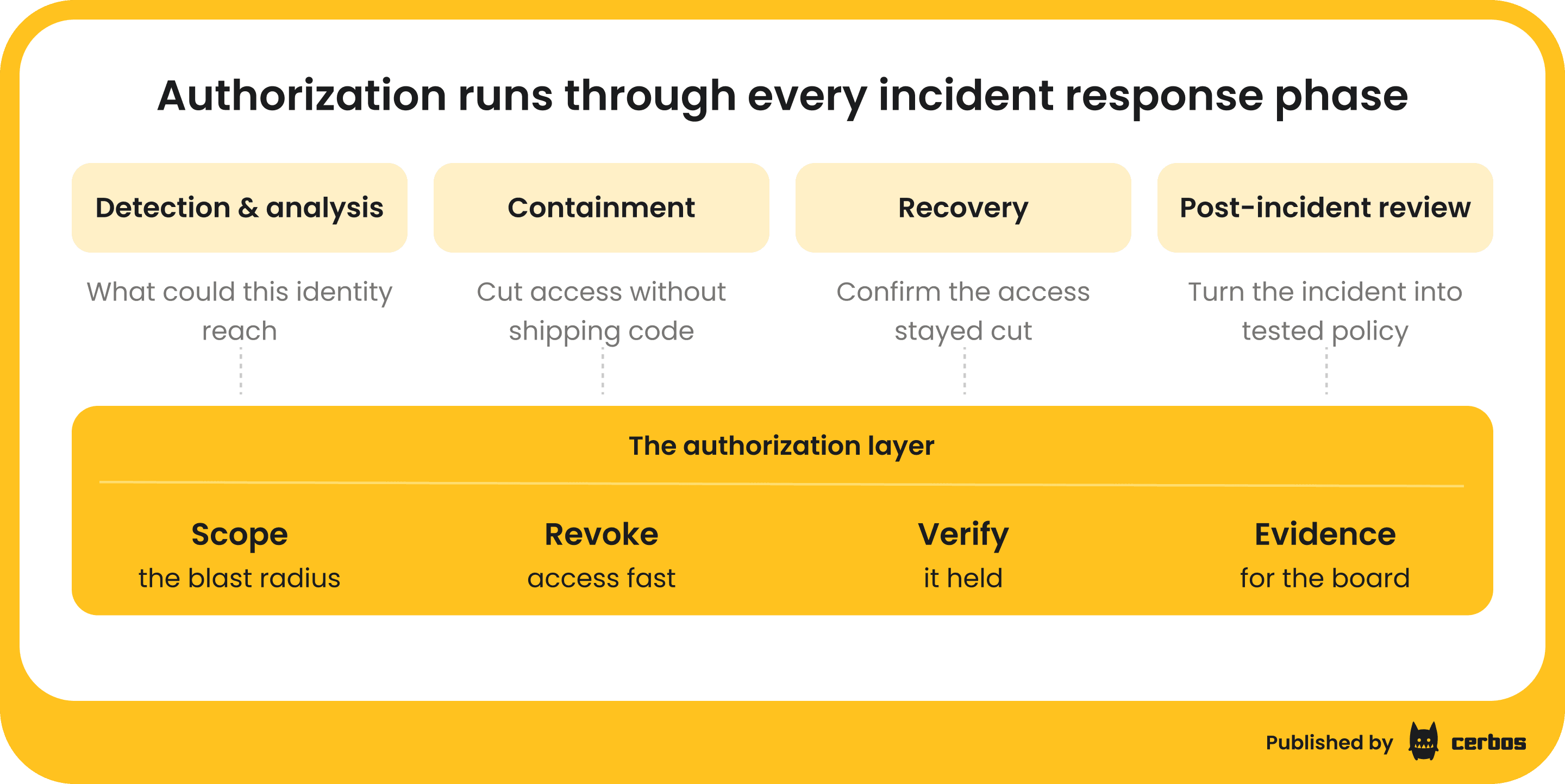
Whether your team anchors its incident response lifecycle to NIST or SANS, the phases are familiar. Detection and analysis, containment, eradication and recovery, then a post-incident review. Authorization is not a separate phase. It runs through all of them.
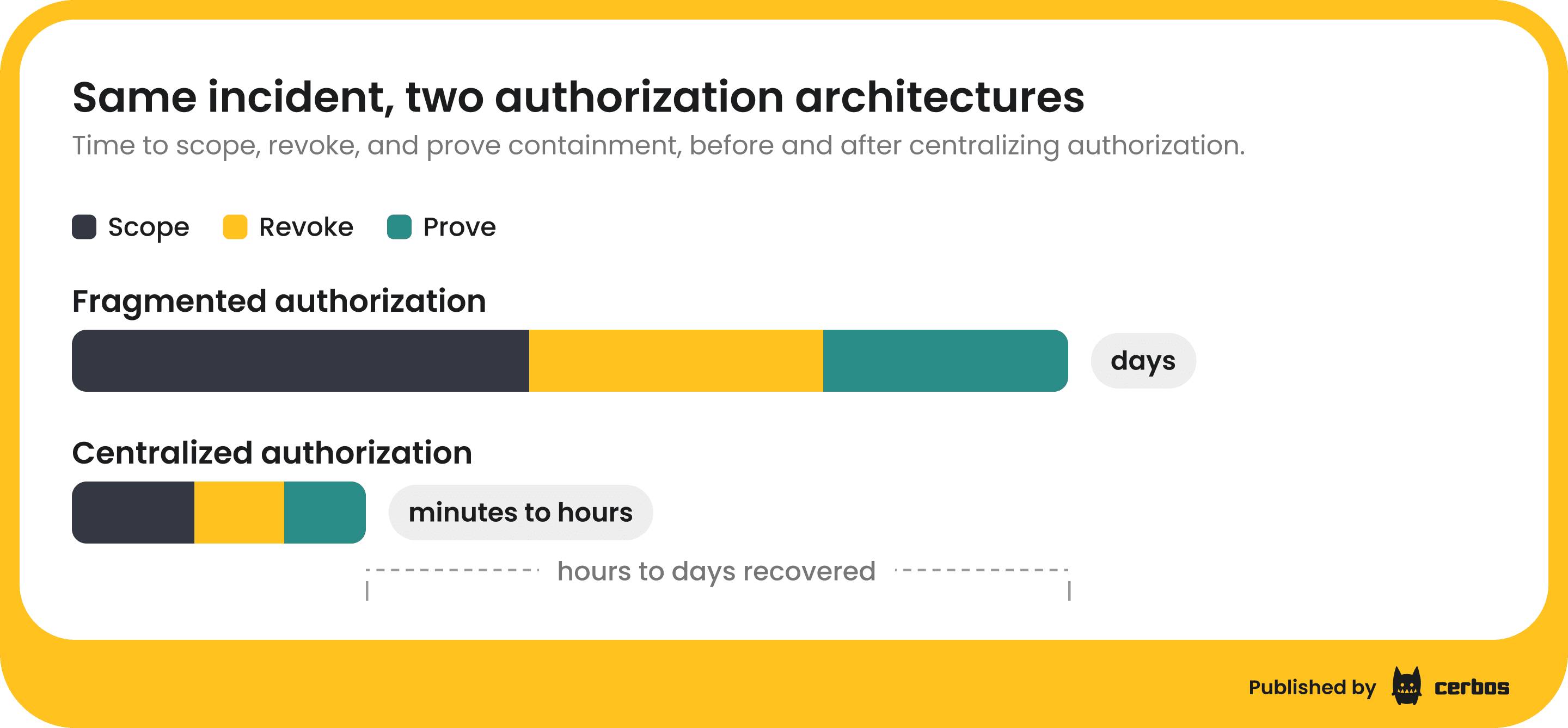
During analysis it tells you the blast radius. During containment it's the fastest lever to cut access without taking systems down. During recovery it's how you confirm the access you cut stayed cut. And in the post-incident review, the decision log is the evidence you hand to the board, the regulator, and the auditor, who all ask a version of the same question. Prove what this account could reach, and prove what you did about it.
When authorization is fragmented, each phase inherits a delay. When it runs through a single decision point with policies as code and a complete decision log, each phase gets a query instead of an investigation.
Step 1. Map the blast radius before the clock runs out
The first real decision in an access-driven incident is scoping. A credential is compromised, an account is behaving strangely, an agent is making calls it shouldn't. Before you contain anything, you need to know what that identity was permitted to do.
In a fragmented environment, scoping means tracing permissions by hand. Someone reads the identity provider groups, someone else greps application code, a third person checks the gateway rules, and the answers arrive as a list of systems rather than a list of permissions. Knowing an account could reach the billing service is not the same as knowing it could read every customer's payment records in the EMEA region. The gap between those two answers is where the hours go, and broken access control has sat at number one on the OWASP Top 10 for two consecutive cycles precisely because that gap is so common.
When every access decision flows through one policy decision point, scoping is a query. You ask what a compromised support account was allowed to do and the answer comes back as specific actions on specific resources, read this customer's record but not export the table, against the policy actually in force right now rather than a diagram from six months ago. This is the practical payoff of fine-grained authorization over coarse role checks. You describe the blast radius at the level of resources and actions, not just systems.
Step 2. Separate what could happen from what did
Scoping tells you the potential. The next question is what the identity actually did, and that's a different data source. Potential access comes from policy. Actual access comes from the decision log.
This is where a lot of response efforts quietly break down. Application logs were built to help engineers debug, not to reconstruct an access timeline. They're inconsistent between services, they rarely capture the policy that was evaluated, and they almost never record why a request was allowed. So the team infers what happened from what should have happened, which is guessing with extra steps.
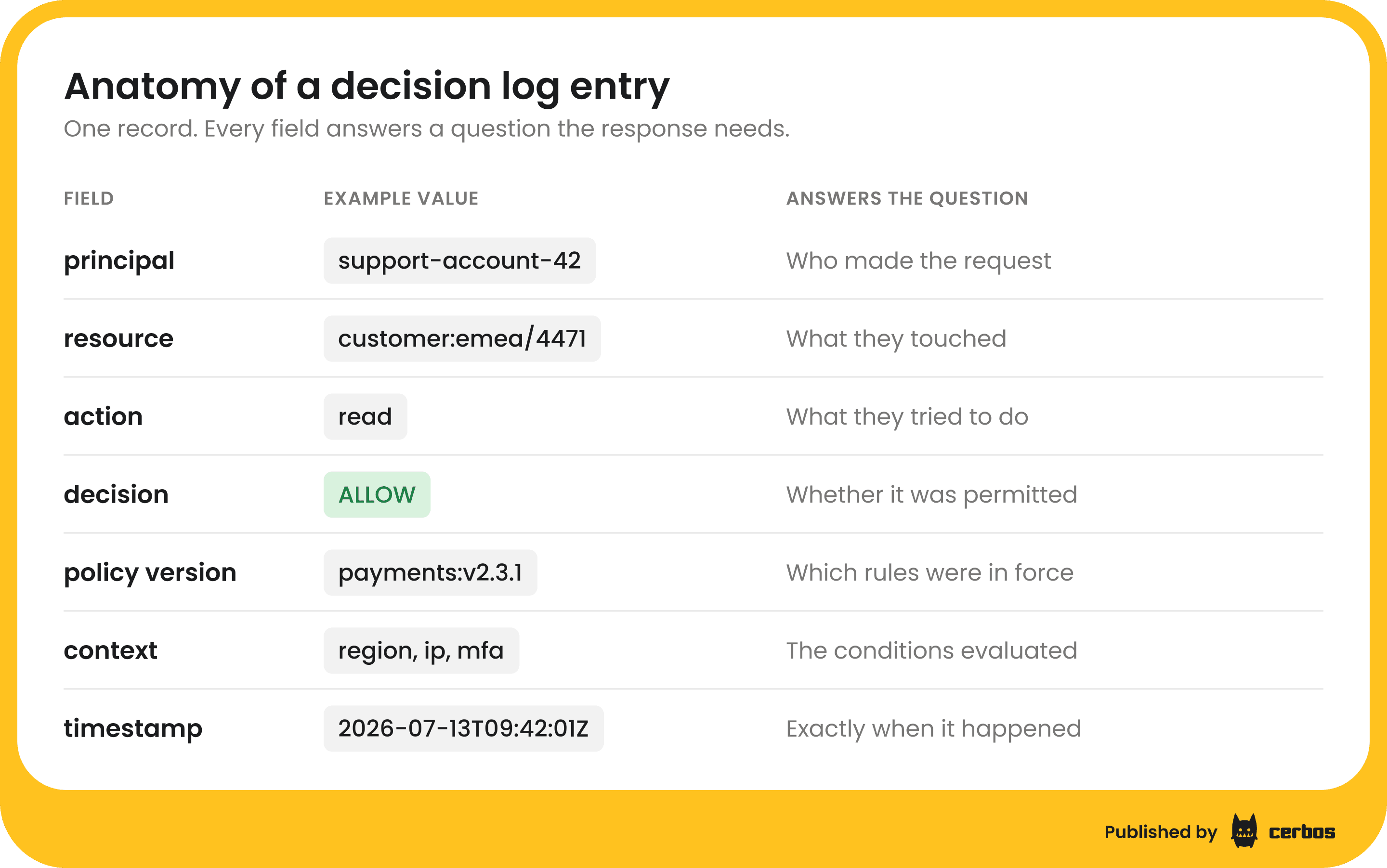
An authorization layer that logs every decision closes that gap as a byproduct of how it works. Each entry records who made the request, what resource and action were involved, whether it was allowed or denied, the policy version that produced the decision, the context evaluated at the time, and a timestamp. During an incident you can ask for every decision made for one identity over the last 48 hours and get a complete, ordered answer. You're inspecting evidence instead of reconstructing intent. That's the difference audit logs make when they're generated by the same system that made the decisions, rather than stitched together afterward.
Step 3. Contain access without shipping code
Once you know the scope and the activity, you contain. Containment of access has a specific failure mode. The revocation is slow, or it's blunt. Slow, because changing what an identity can do means changing application code, getting it reviewed, and shipping it while the incident is live. Blunt, because the only fast lever available is disabling the account entirely, which stops the legitimate work along with the malicious activity.
Policy-based authorization gives you a narrower and faster option. Because the rules live in policy rather than in code, you change what an identity is allowed to do by changing the policy, not the application. You can scope a compromised service account down to read-only, deny one action on one resource type while leaving everything else running, or revoke a single agent's access to a single tool without touching the model or the orchestration around it. The enforcement points pick up the change without a redeploy.
Two properties matter here, and both are worth testing during an evaluation rather than taking on faith. The change has to propagate fast, because a revocation that takes twenty minutes to reach every enforcement point is a twenty-minute window. And it has to be reversible cleanly, because containment decisions made at 3am are sometimes wrong, and rolling a policy back should be as quick as rolling it forward. Policies kept in version control with a full history give you both. Je Sum Yip, Chief Engineer at Human Managed and Cerbos customer, put the everyday version of this plainly. "Having to modify authorization is a five-minute job now. Having to troubleshoot authorization is a five-minute job." An incident is the moment that five-minute number stops being a convenience and becomes containment speed.
Step 4. Prove the containment held
Cutting access is not the same as proving access was cut. The board will ask whether the departed insider still has a way in. The regulator will ask you to demonstrate it, not assert it. Attestation from a team is not evidence. A log entry that shows the subsequent access attempts being denied is.
Fragmented environments handle this worst, because proof of a negative requires complete coverage. If some services log denials and others don't, you can show access was removed from the parts you can see, not that it was removed everywhere. When every enforcement point queries the same decision point, the log that scoped the incident now shows the containment taking effect. You can point to the moment the policy changed and the denials that followed it. Time-to-revoke stops being a story and becomes a number, with the log line that proves it.
Step 5. Close the loop after the incident
The post-incident review is where most of the durable value shows up, and it's the phase teams most often skip because the pressure is off. The question worth answering is not only what happened, but what the policy should have prevented and didn't.
Because the policies are code, this review is concrete rather than philosophical. You can diff the policy as it stood during the incident against the version you want going forward, test the change against the decisions from the incident to confirm it would have denied the access that hurt you, and deploy it through the same reviewed pipeline as any other change. The incident becomes a test case that stays in the suite, so the same gap can't reopen silently later. That feedback loop, from a real event back into tested policy, is what turns incident response from a recurring fire drill into a program that tightens over time.
Making this workflow real in your environment
A workflow only matters if it runs where your systems actually live, and this is the concern that separates evaluation from theory. Three questions come up in almost every architecture review.
The first is latency. An authorization check sits in the path of every request, so the decision has to be deterministic and local, not a slow call to something far away. A stateless policy decision point running as a sidecar or nearby service evaluates checks in sub-millisecond time and scales horizontally with traffic, so the runtime decision stays fast and predictable. Heavier analysis of access patterns happens upstream and offline.
The second is deployment. Regulated and government environments often can't send authorization data to a third-party cloud, and some can't reach external services at all. Decision logs record who accessed what, which is some of the most sensitive operational data you hold, so where it lives is a compliance question as much as a technical one. An authorization layer that runs self-hosted, in your own data center or a fully air-gapped network, keeps that data inside your perimeter and keeps working when external connectivity doesn't. That matters for GDPR, DORA, NIS2, HIPAA, and PCI DSS, which all weigh data residency and demonstrable access control.
The third is whether it fits the stack you already run. Externalizing authorization doesn't mean replacing authentication or rewriting every service at once. The enforcement points work with your existing identity provider, and the sensible path is to bring your highest-risk services under the central layer first. Legacy systems and commercial software that can't call a decision point directly can still be governed at the API or proxy layer in front of them, which brings them into the same workflow without a rewrite. You get the benefit on the systems that matter most, early, without a multi-year migration in the way.
AI agents change the runbook
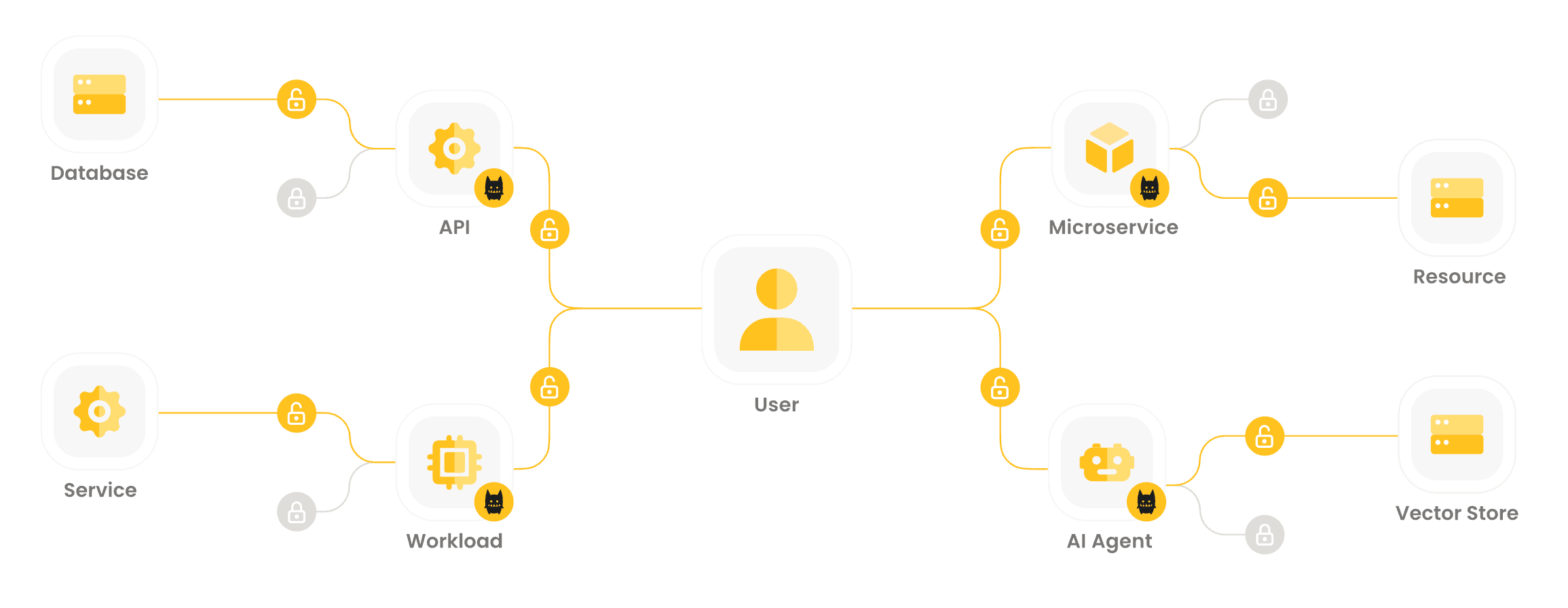
Everything above applies to human users and service accounts. AI agents add a wrinkle worth calling out, because agents are being deployed faster than most authorization programs are being extended to cover them. Across our own work with security teams and conversations at events like Gartner IAM, Identiverse, and EIC, the pattern is consistent. The board approved AI, budget started flowing, and the security team found out what the agents could reach somewhere between the proof of concept and the go-live.
For incident response, agents introduce the confused deputy problem. An agent usually holds broader privileges than any single user it acts for, so an attacker who can influence the agent may get it to use those privileges on their behalf. If authorization is only checked at the prompt, or only at the agent's own identity, a compromised agent becomes a lateral movement engine. The workflow that contains this is the same one above, applied a layer deeper. The full request chain, from the user to the orchestrator to the agent to the tool it's calling, has to be authorized at each hop, so a decision can account for both the agent's identity and the human it's acting for.
Treat an agent's tool calls and its MCP server connections as API calls through the same decision point, and the agent is subject to the same scoping, instant revocation, and decision log as everything else. You can answer what it could access right now, and cut it, in the same motion you'd use for a compromised user. Governing non-human identities under the same policy model as human ones keeps the fastest-growing part of your estate inside the runbook instead of outside it.
The business case, in the terms your board uses
The reason this workflow earns budget is that every phase it compresses maps to a number the business already tracks. Breach cost scales with time. IBM's 2025 Cost of a Data Breach report put the global average at $4.44 million and the US average at a record $10.22 million, found the mean time to identify and contain a breach was 241 days, and found that organizations using security AI and automation extensively cut their breach lifecycle by an average of 80 days and saved close to $1.9 million. Authorization is a consistent bottleneck inside that window, and one of the few you can shorten with an architectural decision rather than more headcount.
There's a compliance dividend outside of incidents too. When the decision log is produced continuously, audit preparation stops being a project with a kickoff meeting and becomes a query against evidence you already have. The weeks a team usually spends assembling access evidence before an audit is time the architecture gives back, every cycle, not only when something goes wrong.
Then there's the part that's specifically the CISO's. When authorization is fragmented across dozens of applications with no unified trail, defending your posture during a regulatory inquiry means arguing that you hoped the controls held. When it runs through one governed layer, you can show what was enforced, when, and why. Most vendor decisions a security leader makes come down to a single test. If this goes wrong, can I defend the choice to my CEO and board. A workflow that produces evidence as a byproduct is about the most defensible answer there is.
How Cerbos fits
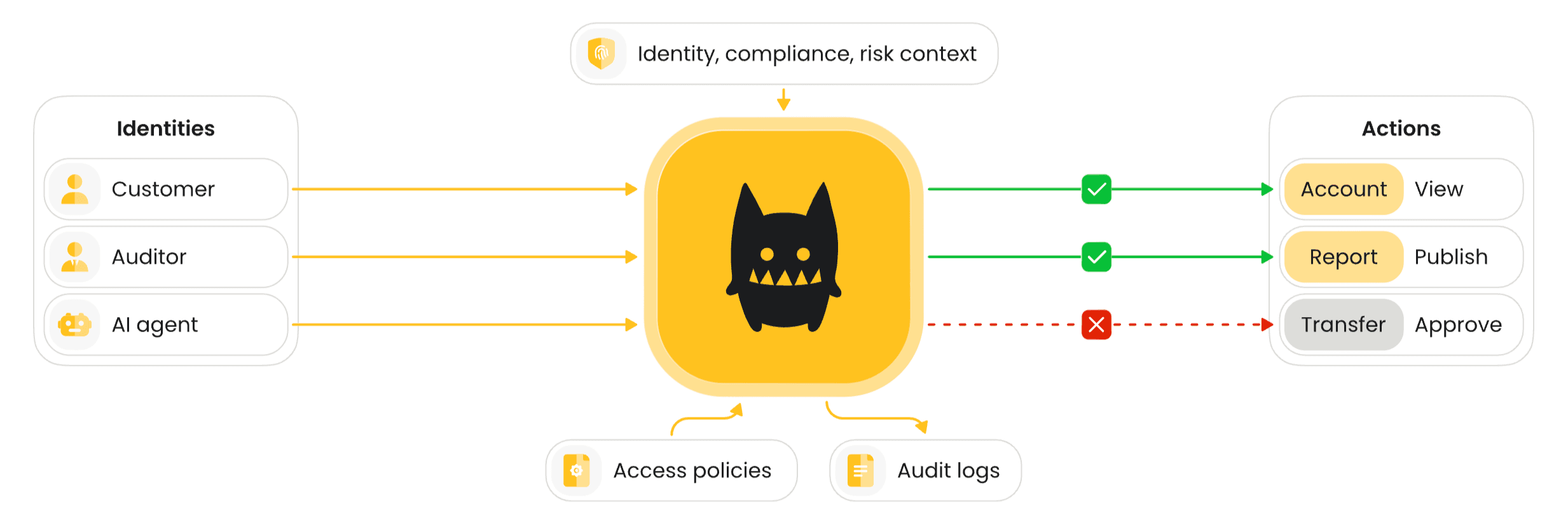
Cerbos is an enterprise-grade authorization management platform built to secure access across complex, distributed environments, SaaS products, and regulated systems. It externalizes authorization logic from application code, making access control consistent and centrally managed across all your services. Designed for Zero Trust architectures and AI-driven systems, it provides continuous, policy-based authorization that scales from local deployments to global production. It supports RBAC, ABAC, and PBAC, so engineering and security teams can model permissions the way the business needs.
The workflow in this piece maps onto four connected components. The open-source Policy Decision Point is the engine that evaluates access logic and returns allow or deny decisions. It's stateless and lightweight, runs anywhere from containers to air-gapped networks, and handles millions of checks per second with predictable latency, which is what keeps scoping and revocation fast.
Enforcement Point SDKs enforce those decisions inside your applications and APIs and work with any identity provider, so the layer drops into the stack you already run.
Cerbos Hub is the management plane for authoring, testing, deploying, and auditing policies at scale, and it's where the version history and unified decision log that carry the containment and evidence steps live. Cerbos Synapse gathers identity, resource, and relationship data from your existing systems and delivers full context to the engine before each decision, so the context your queries depend on during an incident is actually there.
With on-premise Cerbos Hub, the full platform runs inside your environment with no data leaving your perimeter, and cloud-hosted and hybrid are equally supported, so the deployment question above has a real answer rather than a single default. It's compliance-ready for SOC 2, ISO 27001, HIPAA, PCI DSS, and GDPR, and the PDP already supports the AuthZEN standard ratified in January 2026, so the layer isn't a lock-in decision. Every decision is logged with the principal, resource, action, policy version, context, and timestamp this workflow depends on.
The question isn't whether your organization needs an incident response workflow for the authorization layer. Every incident already has one, whether it's designed or improvised. The question is whether, the next time the clock starts, you're running a query or starting an investigation.
Try Cerbos to see how policy-based authorization and unified decision logs work in practice, or book a call to walk through your incident response and architecture with the team.
Go deeper:
- The IAM security checklist for a structured way to find IAM gaps before an incident does
- eBook: The Authorization Maturity Model: A CISO's Benchmark for a self-assessment that places your authorization program on a four-stage scale, plus a 30/60/90 day plan for closing the gaps it surfaces.
FAQ
Tagged in