

AI authorization
Policy-based guardrails for AI agents
Secure agentic workflows, RAG pipelines, and MCP servers with policy-driven access control and full decision logging.

Reduce hidden AI access risks
Remove fragmented, in-code authorization that creates blind spots and over-privileged AI.

Control authorization logic
Define, approve, and update policies in one place for agents, users, and services.

See and stop AI access instantly
Use an AI agent kill switch to revoke access in real time. See exactly what each agent is allowed to access.








Build your AI security strategy
Control access for every identity, at any scale
Enforce fine-grained, contextual authorization across apps, APIs, services, and AI systems from a centralized control layer.
Launch production-ready AI systems with Cerbos
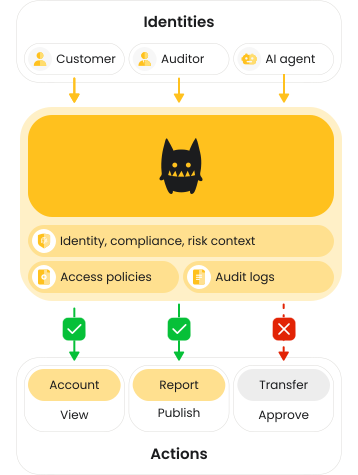
Identity systems establish who someone is. Cerbos controls what they are allowed to do, at the moment decisions are enforced.
1
Every action is checked
When a user clicks a button, a service calls an API, or an AI agent uses a tool, the request is sent to Cerbos.
2
The request is evaluated
Cerbos reviews who is making the request, what they want to do, what they want to access, and the surrounding context.
3
The decision is enforced
Cerbos returns ALLOW or DENY. The application follows that decision before the action runs.
Access control for AI agents and every other use case
Cerbos is an authorization management platform that scales with your business.

AI systems
authorization
AI systems authorization


Enterprise software
authorization
Enterprise software authorization


Authorization software that scales with your business

ABAC
RBAC
ReBAC
PBAC
Runtime
Event-time
Admin-time
Audit-time
Cloud
Self-hosted
On-premise
Air-gapped
Non-human identities
Human identities
Workloads
Weak authorization is how breaches start. AI scales the mistake.

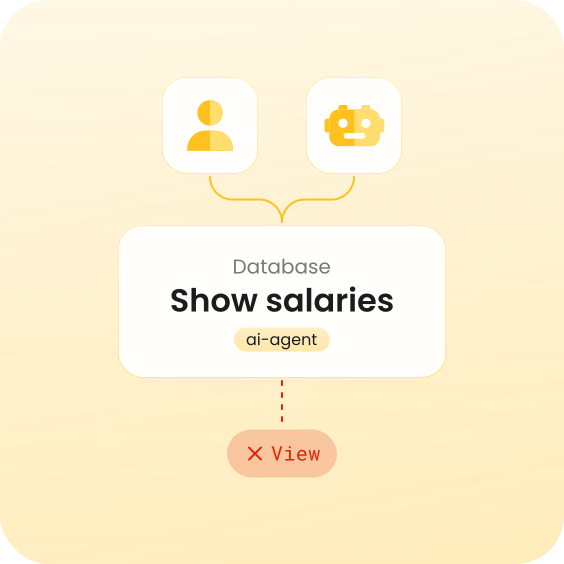
Over-permissioned access
AI agents and services can do more than they should. One mistake can expose sensitive data or trigger unauthorized actions.

Gaps between systems
When access rules live in different services, decisions become inconsistent. Attackers exploit those gaps.

Access that never expires
Long-lived tokens and shared credentials stay valid long after they are needed, increasing the chance of compromise.

No way to stop it instantly
If an agent goes beyond its scope, access continues until someone rotates credentials or restarts systems.
Become compliance-ready with every access decision, AI or human


SOC 2

SOC 3
HIPAA

ISO 27001

GDPR

FedRAMP

PCI DSS

NIS2

DORA
SOC 2
SOC 3
HIPAA
ISO 27001
GDPR
FedRAMP
PCI DSS
NIS2
DORA

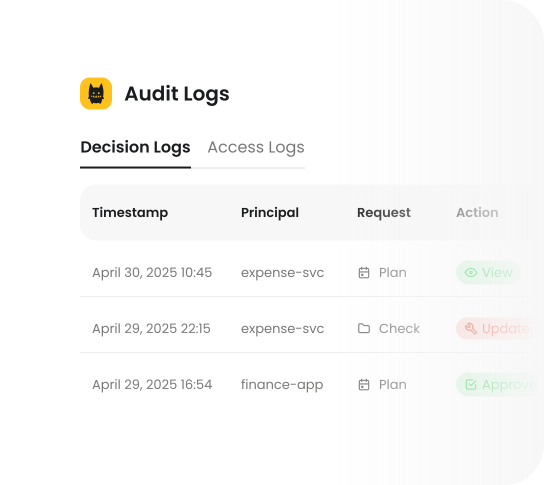
Capture every decision for all identities
Log requests, actions, resources, access outcomes, and service-to-service authorization calls for both humans and machines.

Trace policy lineage
See the exact policy, version, and release behind each decision for complete traceability.

Monitor with context
Review detailed logs, policy versions, and real-time metrics across all PDPs and environments.

Simplify audits and compliance
Maintain centralized, structured logs on-premise to support audits and demonstrate readiness for FedRAMP, SOC 2&3, ISO 27001, HIPAA, PCI DSS, and GDPR.

Plug into your existing stack
Go live with authorization in one sprint

MCPs
Integrate Cerbos authorization with Fasten MCP and Anthropic MCP to control agent workflows at the orchestration layer.


Vector stores
Enforce policy-based access for embeddings and retrievals across FAISS, Pinecone, Weaviate, Chroma, and Qdrant.


AI infrastructure
Deploy Cerbos policies alongside your AI model APIs. Works with OpenAI, Anthropic, Groq, and other inference providers.


SDKs
Use Cerbos SDKs for languages like JS, Python, Go, Rust, Java, and .NET to authorize requests from your application code.





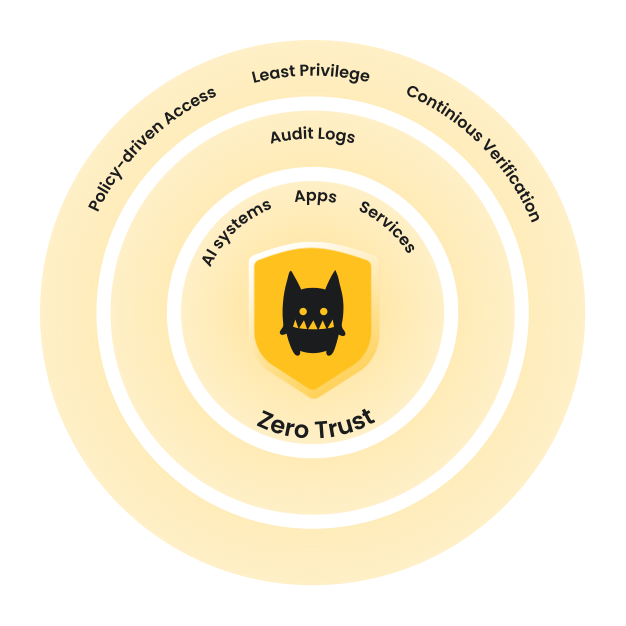
Implementing Zero Trust with Cerbos
Why engineering teams love Cerbos
Recognized by the community
Award-winning technology, built for security and scale
With a strong open source foundation, active AuthZen membership, and multiple industry awards, Cerbos has been recognized as a secure and reliable authorization software since 2021.

Hackernoon Startup Awards 2025

Startups 100 Index 2025

API World 2025 Awards

Intellyx Digital Innovator 2023
Purpose-built authorization, not a generic policy engine
 Generic policy engines |  Cerbos Hub |
|---|---|
Policy language General-purpose policy languages designed for broader use cases. | Policy language YAML policies purpose-built for authorization, readable by security teams. |
Authorization model Authorization patterns must be assembled from generic primitives. | Authorization model First-class RBAC, ABAC, and PBAC with principal/resource/action semantics. |
Evaluation latency Varies by policy complexity and engine architecture. | Evaluation latency Sub-millisecond, optimized for per-request evaluation at machine speed. |
Policy lifecycle Custom sync, manual distribution, separate CI/CD tooling. | Policy lifecycle Cerbos Hub: managed policy lifecycle with CI/CD, testing, and real-time distribution. |
Audit and compliance Decision logs require additional infrastructure to capture and correlate. | Audit and compliance Structured decision logs with policy version lineage, built in. |
Learn more about AI security
Authorization for enterprise software and AI
Externalized, policy-based, runtime authorization for your apps, enterprise software, AI systems and workflows.