Authorization for legacy applications
Add policy-based authorization, audit trails, and context-aware access control to the systems your team has been telling you can't be governed.

Eliminate your biggest authorization blind spot
Legacy systems hold your most sensitive data with the least visibility. Get a full audit trail across legacy and modern systems in one place.

Always know who can access what
Gain real-time visibility into access across systems that were previously ungoverned. Role, device posture, risk score, location, all factored into every decision.

Prove compliance at any time
Produce audit evidence for legacy systems in seconds. Decision logs meeting SOC 2, ISO 27001, HIPAA, GDPR, NIS2, DORA, FedRAMP requirements.


Deploy in an afternoon, enforce when you're ready
Start in observe mode with no deny rules. See how the system is actually used. Write policies based on real access patterns. Move to enforcement on your timeline.

Same policy language you already use
Write route-level policies in YAML with CEL conditions. Same Cerbos policy framework as your modern services, just a different integration point.

No one comes back to you for permission changes
Security and identity teams manage policies in Cerbos Hub. Role changes happen in the IdP. No code deploys, no engineering tickets for access updates.

Extend your governance reach to legacy systems
Gain visibility into what every identity can do inside apps your IAM stack has never been able to govern. Your IdP becomes the source of truth for access.
Close the JML lifecycle gap
Your IGA provisions roles. Cerbos controls what roles can do at the resource level, at runtime. When someone changes roles or leaves, access updates on the next request.

One authorization view across your entire estate
See every access decision for legacy and modern systems in the same place. No more fragmented authZ logic outside your governance reach.



































Legacy applications are the biggest authorization risk
They hold the most sensitive data but sit outside every governance framework.

No visibility into who accesses what
Access logs sit in files on a VM somewhere, if they exist at all. Security and identity teams have no structured record of who's using these systems, what they're accessing, or whether that access is appropriate.

Authorization outside your governance reach
Access controls are hardcoded by whoever built the application years ago. Your IdP assigns roles, but those roles don't reach the permissions inside the app. The JML lifecycle has a gap that auditors will find.

Compliance evidence you can't produce
Auditors ask "who has access to what in this system?" and the answer is a scramble. No structured audit trail. No policy-as-code. No way to demonstrate consistent enforcement across the estate.


“$52 million settlement. 131 million users exposed. Multi-year breach.”
- Marriott International, 2024
Cerbos adds authorization governance to your entire estate, including legacy applications
A single authorization platform for modern services, infrastructure, and legacy applications you can't modify.
See exactly who's accessing what across every system, including legacy applications that previously had no audit trail. Deploy in observe mode and get a complete record of every access decision from day one. Write enforcement policies based on real access patterns, not guesswork.

How Utility Warehouse achieved continuous compliance across thousands of services and millions of NHIs with Cerbos.
4,500 services
Millions of decisions daily
SOC 2 & ISO audit-ready
“We had no idea what our services were doing on behalf of users. Once a request passed the edge, the identity and the intent got lost. Now even our legacy apps follow the same access rules as our microservices. Cerbos gives us one model to rule them all, whether it's new code or old vendors.”


Rob Crowe
Principal Engineer, Utility Warehouse

Built for enterprises
How Cerbos works with legacy applications
1
Deploy Envoy or alternative in front of the application
Configure Envoy as a reverse proxy with OAuth2/OIDC authentication against your identity provider.
2
Connect Cerbos Synapse for authorization
Authorize the request through the proxy via Cerbos Synapse. Connect Synapse to your Cerbos Hub workspace.
3
Write route-level policies
Define who can access which routes using YAML policies. Test them in Cerbos Hub before deploying.
4
Add context and tighten
Pull in device posture, risk scores, and other signals through data source extensions. Move from observe mode to active enforcement.
Access control for every use case
Single authorization management platform for every identity, every decision, at every layer.

AI systems
authorization
AI systems authorization



Enterprise software
authorization
Enterprise software authorization


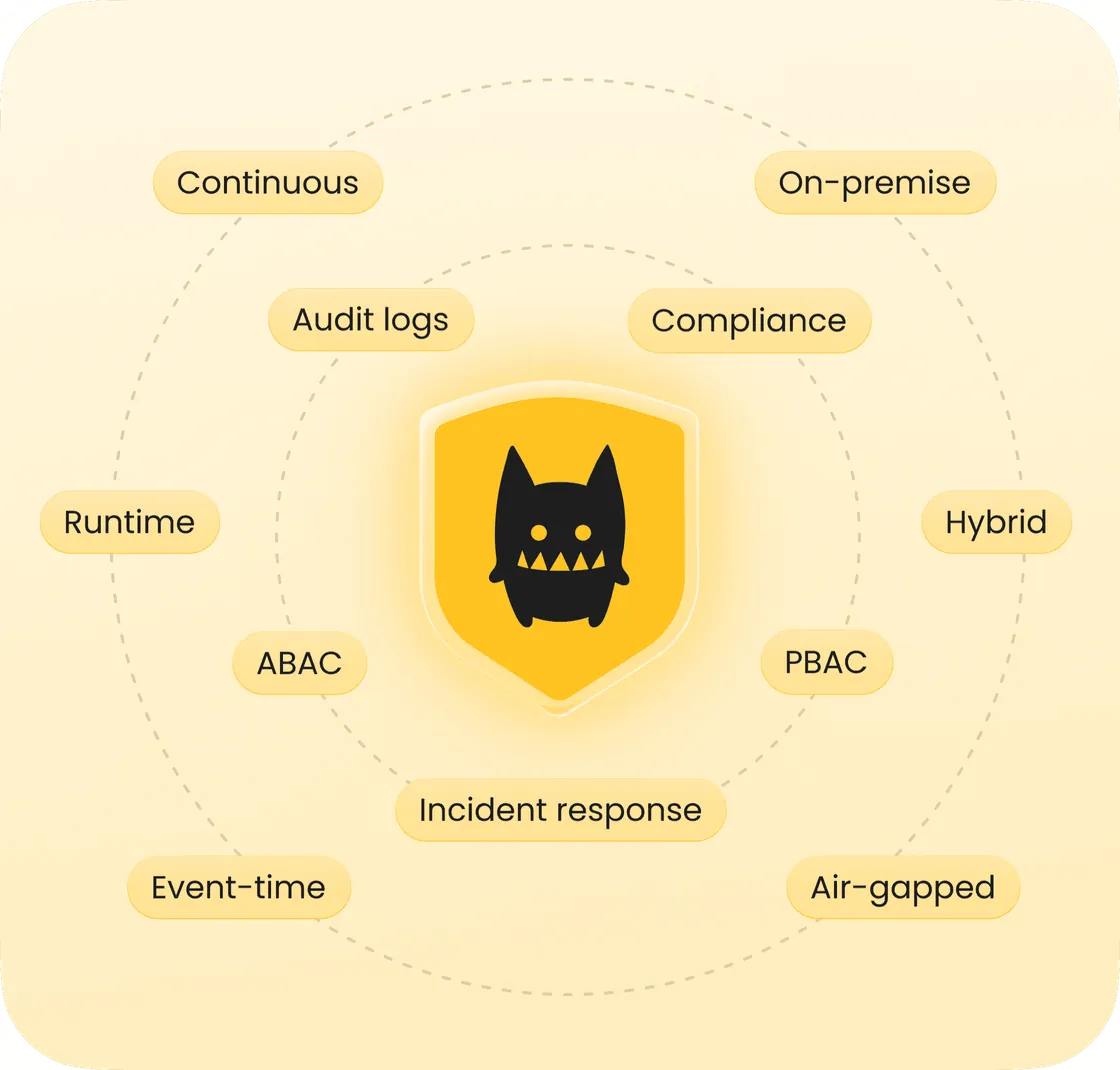
Authorization software that scales with your business

ABAC
RBAC
ReBAC
PBAC
Runtime
Event-time
Admin-time
Audit-time
Cloud
Self-hosted
On-premise
Air-gapped
Non-human identities
Human identities
Workloads

Runtime authorization for Zero Trust
Be compliance-ready with every access decision, human or AI


SOC 2 & 3

ISO 27001

PCI DSS

GDPR

HIPAA

FedRAMP

NIS2

DORA

Seamless integration
Authorization that fits your stack













Fine-grained identity security
Why teams choose Cerbos

"When I did an audit, I found that the cost of managing authorization and authentication in-house over the entire lifespan of the company was in the 7 figures. Cerbos saved that. Deploying Cerbos has allowed our engineers to spend their time on what really matters for our success."

Chuck Hardy
Head of Engineering @Salesroom

"Having to modify authorization is a five-minute job now. Having to troubleshoot authorization is a five-minute job. So that has actually allowed the team to spend more time where it really matters on the platform."

Karen Kim
CEO @Human Managed

"We rely on Cerbos to make authorization decisions across the whole mesh - millions of times a day. And it’s fast. We don’t even think about it anymore. It just works."

Rob Crowe
Principal Engineer @Utility Warehouse

"We went from one user - every role, to a world where there are many users - many roles. And the product, it relies on Cerbos to actually bring the value that we want to bring to customers. All of our customers are relying on Cerbos, by relying on the product, which is of course relying on Cerbos."

Joe Lines
CEO & Co-Founder @Nook

"One of our big considerations was speed. We have strict latency tolerances. When it comes to Cerbos - you can call it a hundred times during a request and it doesn't matter. It's incredibly fast."

Steve High
Staff Engineer @Complex

"The main reason we switched to Cerbos was to have a sophisticated authorization software to help organize and handle our authorization. We wanted to focus on domain related features and spend less time backtracking and fixing issues with our authorization."

Lead Software Developer at @BarrierSystems

"Cerbos enables us to go to market very quickly, compared to an in-house solution. It allows us to offer new products faster, because creating or editing policies is so easy."

Engin Attar
Head of Product and Growth, Co-Founder @Debite

"We got the foundation set. Now we can scale and include more complex policies. And we can grow in the right direction and with the right security thanks to Cerbos authorization management."

Edgar Rivera
CTO @4gcapital
"Having the separation of the permissions from the code base just makes the code base more elegant. It makes the permissioning more elegant. It means they're centralized, so they're not tied to specific endpoints. And ultimately it means that different business owners have the ability to actually make updates."

Henry Arnold
CTO & Co-Founder @Nook
"We're not worried about scaling because we can easily increase our load on Cerbos. It will also be easy for us to change how we're distributing policies as we reach different points of scale."

David Workman
Senior Software Engineer @ Salesroom

"Offering dynamic roles and permissions makes us more competitive in the market. We’re providing companies with a software that can be adapted to their workflows."

Ibrahim Bou Ncoula
CTO @Supy
"We can create unlimited conditions, attributes, and parameters at any level of granularity without writing any code. It allows us to deliver truly personalized services quickly, securely, and at scale."
Karen Kim
CEO @Human Managed
"When I did an audit, I found that the cost of managing authorization and authentication in-house over the entire lifespan of the company was in the 7 figures. Cerbos saved that. Deploying Cerbos has allowed our engineers to spend their time on what really matters for our success."
Chuck Hardy
Head of Engineering @Salesroom
"Having to modify authorization is a five-minute job now. Having to troubleshoot authorization is a five-minute job. So that has actually allowed the team to spend more time where it really matters on the platform."
Karen Kim
CEO @Human Managed
"We rely on Cerbos to make authorization decisions across the whole mesh - millions of times a day. And it’s fast. We don’t even think about it anymore. It just works."
Rob Crowe
Principal Engineer @Utility Warehouse
"We went from one user - every role, to a world where there are many users - many roles. And the product, it relies on Cerbos to actually bring the value that we want to bring to customers. All of our customers are relying on Cerbos, by relying on the product, which is of course relying on Cerbos."
Joe Lines
CEO & Co-Founder @Nook
"One of our big considerations was speed. We have strict latency tolerances. When it comes to Cerbos - you can call it a hundred times during a request and it doesn't matter. It's incredibly fast."
Steve High
Staff Engineer @Complex
"The main reason we switched to Cerbos was to have a sophisticated authorization software to help organize and handle our authorization. We wanted to focus on domain related features and spend less time backtracking and fixing issues with our authorization."
Lead Software Developer at @BarrierSystems
"Cerbos enables us to go to market very quickly, compared to an in-house solution. It allows us to offer new products faster, because creating or editing policies is so easy."
Engin Attar
Head of Product and Growth, Co-Founder @Debite
"We got the foundation set. Now we can scale and include more complex policies. And we can grow in the right direction and with the right security thanks to Cerbos authorization management."
Edgar Rivera
CTO @4gcapital
"Having the separation of the permissions from the code base just makes the code base more elegant. It makes the permissioning more elegant. It means they're centralized, so they're not tied to specific endpoints. And ultimately it means that different business owners have the ability to actually make updates."
Henry Arnold
CTO & Co-Founder @Nook
"We're not worried about scaling because we can easily increase our load on Cerbos. It will also be easy for us to change how we're distributing policies as we reach different points of scale."
David Workman
Senior Software Engineer @ Salesroom
"Offering dynamic roles and permissions makes us more competitive in the market. We’re providing companies with a software that can be adapted to their workflows."
Ibrahim Bou Ncoula
CTO @Supy
"We can create unlimited conditions, attributes, and parameters at any level of granularity without writing any code. It allows us to deliver truly personalized services quickly, securely, and at scale."
Karen Kim
CEO @Human Managed
Go deeper on legacy application authorization


Start securing legacy applications with policy-based authorization
Our team will walk you through how Cerbos fits into your stack and show you what authorization governance looks like across your legacy estate.