Tech blog
Demos, implementation guides, product updates and broader takes on authorization, identity and security.
Kubernetes admission control does not need a second policy language
Platform teams usually keep two sets of access rules, one for what may be admitted into the cluster and one for what users may do in the applications there. Covers serving the admission webhook from the same policy layer, what a full ruleset looks like, and failure policy trade offs.
Not every authorization decision is allow or deny
Not every authorization decision is allow or deny. Some denials are conditional, and the policy can return what would unblock them. Covers Cerbos policy outputs, the conditionNotMet trigger, the AuthZEN ARAP draft profile for requestable denials, and why an approval is an input to a new decision.
What is authorization? Types, examples and definitions
Learn what authorization is all about! Explore several key authorization design patterns, how they work, and possible scenarios where they may be implemented. This guide covers RBAC, ABAC, PBAC, DAC, MAC, and ReBAC, how authorization differs from authentication, how it works with tokens and OAuth scopes, real-world examples, and best practices for getting it right.
Istio authorization stops at identity, not at what a workload may do
Istio proves which workload is calling with mTLS and SPIFFE, and stops there. This guide covers where AuthorizationPolicy runs out, handing the decision to an external authorizer through the CUSTOM action, running one policy set across north south and east west traffic, and what the extra network hops cost.
Stale JWT claims in authorization, and how to look up identity attributes at decision time
How to resolve identity attributes at decision time rather than reading stale JWT claims. Covers Envoy verifying the token while a Synapse data source fetches current profile and group data, policies that read attributes rather than claims, per source cache expiry, and failure behavior when the provider is unreachable.
Policy-driven MCP routing: enforcing tool gates outside the agent
Telling an agent which tools not to use is a request, not a control. Here is how to gate MCP tool calls with policy enforced outside the agent, at the execution boundary.
Full guide to Next.js authorization & authentication
Next.js has two main patterns of authentication. Meanwhile when it comes to authorization, nothing is as simple as adding Cerbos. Read our full guide.
Open source Cerbos vs paid Cerbos
Open source vs paid Cerbos explained. The Apache 2.0 engine is complete and free, running over 2 billion checks a month. See what the commercial platform adds around it, policy distribution, compliance audit, and data enrichment, plus the roughly 19 engineer months it takes to build the equivalent yourself.
Delegated authorization: Why acting on behalf of someone else is not a role
Delegated authorization explained. Why modeling on-behalf-of access as a role loses the subject, the approver and the expiry. Covers the RFC 8693 act claim, delegation versus impersonation, AuthZEN and COAZ, multi-party policy conditions, revocation before expiry, and audit lineage for delegated actions.
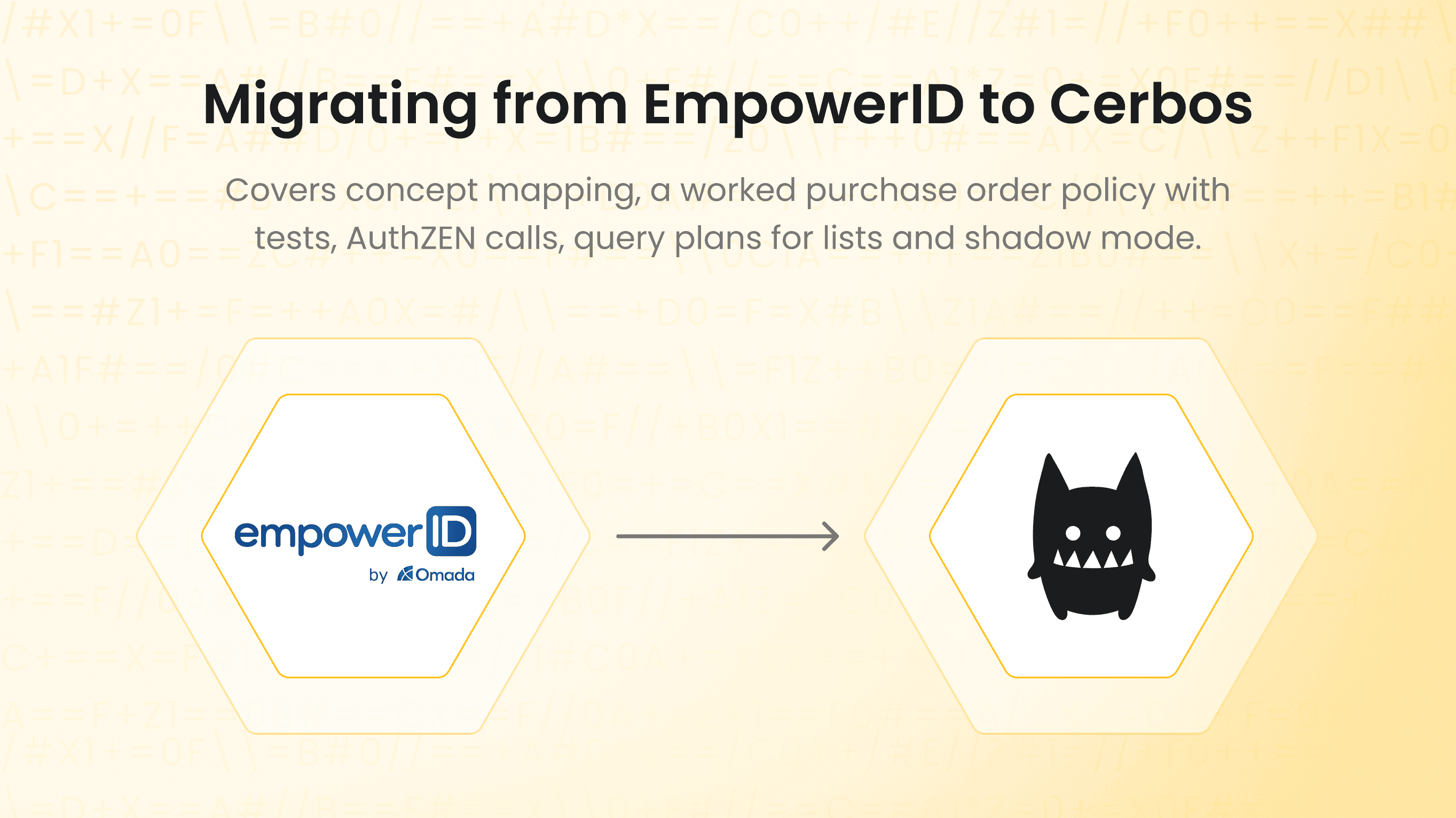
Migrating from EmpowerID to Cerbos
Migrating from EmpowerID's authorization to Cerbos, one application at a time. What stays in EmpowerID, what moves, how roles and Field Type conditions become Cerbos policy, and how to prove the new decisions match before you cut over.
Cerbos included in the KuppingerCole Leadership Compass on API Security and Management
Cerbos is included as a vendor in the KuppingerCole Leadership Compass on API Security and Management. This post explains why API gateway authorization splits between the gateway and the service behind it, how one policy decision point closes the gap, and what AuthZEN, context enrichment and audit records change.
MCP server vetting checklist for enterprises
Every MCP server you connect is a third party you have handed an agent a door to. Here is a practical checklist for vetting MCP servers and governing the ones you cannot fully trust.