Once you accept that authorization is a runtime problem, the question becomes how you govern it without turning your system into a bottleneck.
The model we work toward is treating authorization as a continuously governed security control. Every access attempt is evaluated against the current context, using a centrally managed policy, and produces evidence you can inspect later. Crucially, this happens without inserting a new network hop or fragile dependency into the critical path.
That constraint matters more than most people expect.
One source of authorization truth
In most environments, policy exists in fragments. Some of it lives in IAM tools, some in application code, some in spreadsheets that only surface during audits.
What we have found works better is clear ownership and a single place where authorization policy is defined, reviewed, versioned, and approved. Not because centralization is fashionable, but because without it, you cannot reason about blast radius or change impact.
With systems like Cerbos, policy becomes explicit. You can answer basic questions like who owns this rule, when it changed, why it changed, and what it affects. That is table stakes for any control you expect to defend under scrutiny.
Consistent decisions, wherever they are enforced
Another place things break down is inconsistency. Different teams reimplement the same authorization logic in slightly different ways. Edge cases drift. Assumptions diverge. Over time, policy intent and runtime behavior no longer match.
The goal is not to centralize enforcement, but to centralize decision logic. The same policy should evaluate the same way whether it is called from an API, a background job, a data pipeline, or an automated workflow.
When decisions are consistent, gaps become visible. When they are not, gaps hide in plain sight.
Decision-level evidence, not just configuration
From an audit and incident response perspective, configuration alone is not enough.
What holds up is decision-level evidence. For each authorization decision, you should be able to see what was requested, which policy version was evaluated, which inputs mattered, and what the outcome was.
This changes how audits feel. Instead of explaining intent and hoping it was followed, you can show what was enforced. Automated audit trails, policy versioning, and reproducible decisions turn authorization from a theoretical control into an inspectable one.
Governance without new runtime risk
A common concern is that adding governance means adding latency or new failure modes. That concern is valid.
In practice, authorization only scales if it runs locally, evaluates fast, and fails safely. If a policy engine becomes a network dependency, teams will bypass it. If it introduces noticeable latency, it will be disabled under pressure.
That is why the design constraint is no new runtime risk. Decisions need to be evaluated in process or close to it, with predictable sub-millisecond performance, even at very high volumes.
Controlling automated actors explicitly
One of the more recent shifts is the growth of automated actors. Service accounts, background jobs, AI agents, and system-to-system integrations now make far more decisions than humans do.
Treating these as second-class identities is a mistake. They need the same level of authorization rigor, context awareness, and auditability as human users, often more.
Runtime authorization makes this possible because policies can reason about identity type, workload attributes, and execution context, not just usernames and groups.
Fitting into the stack you already have
Finally, none of this works if it requires ripping out existing systems.
Authorization should consume signals from your current identity and governance stack, not compete with it. Directories, IdPs, and IGA tools already tell you who someone is and what they should generally have access to. Authorization decides what is allowed right now.
When those responsibilities are clearly separated, systems get simpler, not more complex.
The pattern that holds up is straightforward. Identity establishes who. Authorization evaluates what, when, and under which conditions. Governance ensures you can explain and prove the outcome later.
If you’re interested in implementing externalized, dynamic authorization - start with our 10-chapter guide for a structured approach to this transformation.
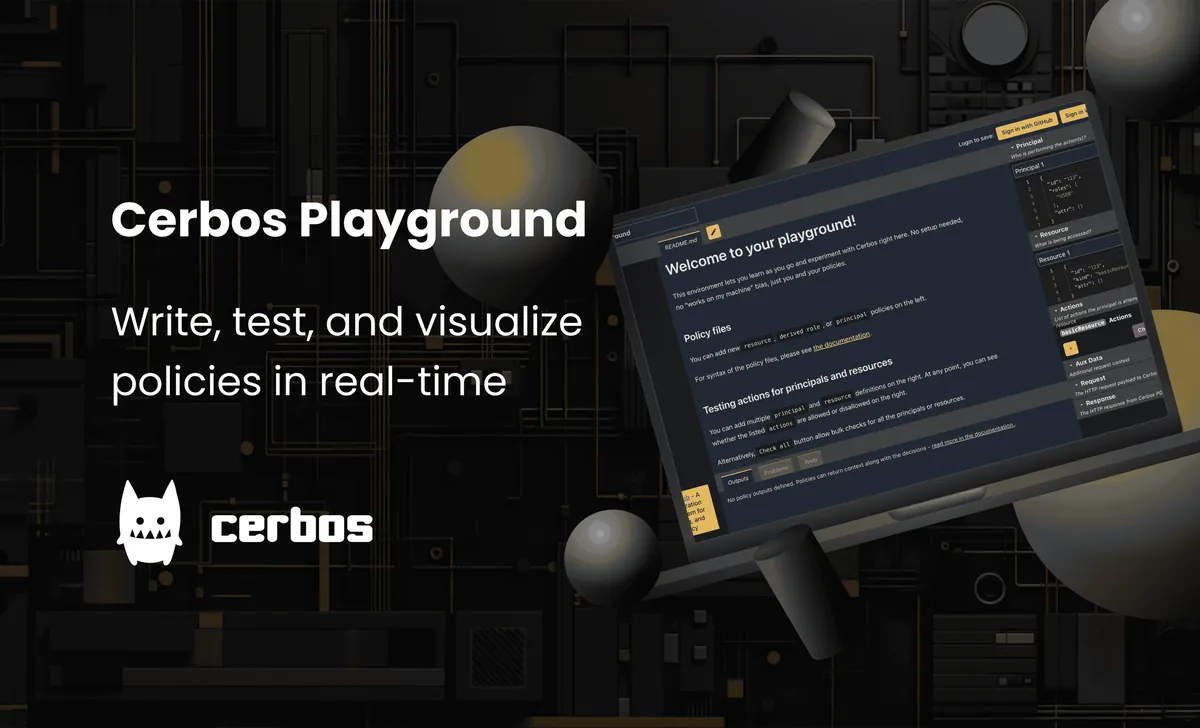
Otherwise, feel free to try out Cerbos Hub or book a call with a Cerbos engineer to see how our solution can help streamline access control and secure your applications.
Tagged in